Everett Historic District
Also known as: Johnnycake; Unionville; See Also:Everett Knoll Complex; Valley
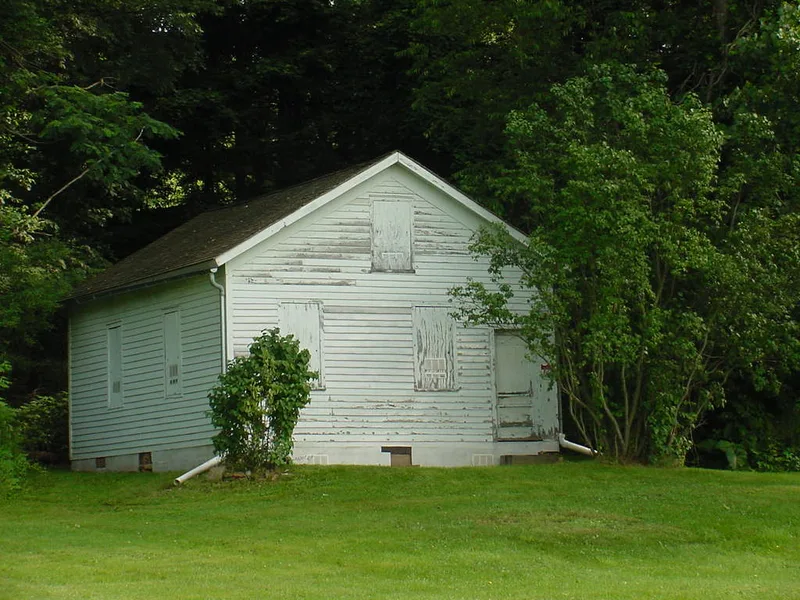

Why it's listed
Everett is a small crossroads hamlet in the Cuyahoga Valley, about nine miles north of Akron, where Everett Road meets Riverview Road. The district covers 17 acres and includes modest one-and-a-half to three-story balloon-frame houses, privies, garages, a gas station and confectionery built around 1930, a general store, and the ruins of wells and a former store. Archeological sites add evidence of early domestic life. The settlement grew up beside the Ohio and Erie Canal and the Valley Railway, and its 1888 population was 200. Farming was the leading occupation, and the community had a school, church, post office, Grange and blacksmith. During the 1920s the automobile and improved roads began to change its agrarian character. The district was listed for its role in settlement and community development, its late nineteenth and early twentieth century architecture, and its archeological potential. Nearby Wait and Hunt farms are excluded because they were nominated separately.
Significance in brief: The nomination argues that Everett is a well-preserved example of a small agricultural crossroads settlement along the Ohio and Erie Canal and the Valley Railway. It is significant for settlement, community planning and development, and historic archeology. Its later shift toward an auto-oriented hamlet in the 1920s and 1930s is also documented.
Machine-generated summary. This summary was generated by a language model from the official nomination document and has not been reviewed line by line by an editor. It may contain errors. Check the source document before relying on any detail. Source: nomination document (PDF) · National Archives catalog entry. NRHP reference 93001467, listed January 14, 1993. Summary generated October 2026 (model claude-sonnet-5-5, prompt v1.0-2026-10-29, confidence medium).
Key facts
| Address | 4731--4642 Riverview Rd. and 2151--2279 Everett Rd., Cuyahoga Valley National Recreation Area, Peninsula |
|---|---|
| County | Summit County |
| Listed | January 14, 1993 |
| Reference number | 93001467 |
| Resource type | District |
| Period of significance | c.1830-1935 |
| Architectural style | Late Victorian; Queen Anne; no style |
| Criteria |
|
| Areas of significance | Community Planning and Development, Historic - Non-Aboriginal |
| Level of significance | Local |
| Status (as stated in the nomination) | Current uses include single dwellings and government offices; some buildings are vacant or not in use. Stabilization work was done on several buildings in 1987. |
| Acreage | 17 |
| Within district | Valley Railway Historic District |
| Coordinates | 41.20406, -81.57182 (NPS GIS) |
What listing means for this property
This is a historic district. Buildings within its boundary are either contributing (they add to the district's significance) or non-contributing. Owners of contributing income-producing buildings can claim the 20% federal rehabilitation tax credit; homeowners should look at state credits. National Register districts impose no design review by themselves; a local historic district ordinance, if one exists, does (the difference explained).
General information, not legal or tax advice. Rules change; confirm with your State Historic Preservation Office or a qualified adviser.
Sources and further reading
- National Park Service, National Register of Historic Places database (snapshot May 2026), reference 93001467.
- Nomination form (PDF, National Archives) — catalog entry
- Wikipedia article (used for cross-checking only; text not reproduced here)
- Wikidata Q5417024
- This listing as JSON
Last updated October 2026. Found an error? See the editorial policy for how to report it.