Loew-Define Grocery Store and Home

Why it's listed
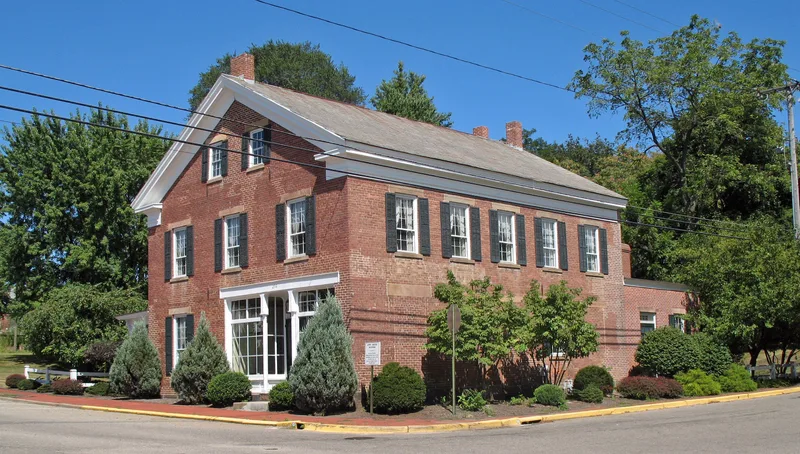
Built in 1850 at 202 S. Market Street in Navarre, Ohio, this 2 1/2 story brick building served as both a grocery store and a home. It has a cut stone foundation, a slate gabled roof, a storefront with a large plate-glass window and transom, and a symmetrical arrangement of openings with stone lintels. Its molded entablature and gable end returns mark it as a Greek Revival commercial building. Navarre was a major wheat shipping center on the Ohio and Erie Canal, with 12 elevators, 11 hotels and 10 dry goods stores at its peak. Few buildings of this style and scale remain. John Loew, a justice of the peace, acquired the property in the 1860s, and a trial there in 1867 reportedly involved the young lawyer William McKinley. The store ran as Loew & Son into the early 20th century, then passed to James D. Define, son of an Italian immigrant, linking it to the neighborhood known as Italy Hill.
Significance in brief: The nomination argues it is a distinctive example of Greek Revival commercial architecture in Ohio, with a molded raking cornice, molded entablature and gable end returns. It also represents the commercial life of Navarre, a canal-era wheat shipping town, and the immigrant history of the Italy Hill neighborhood.
Machine-generated summary. This summary was generated by a language model from the official nomination document and has not been reviewed line by line by an editor. It may contain errors. Check the source document before relying on any detail. Source: nomination document (PDF) · National Archives catalog entry. NRHP reference 79001954, listed November 29, 1979. Summary generated October 2026 (model claude-sonnet-5-5, prompt v1.0-2026-10-29, confidence high).
Key facts
| Address | 202 S. Market St, Navarre |
|---|---|
| County | Stark County |
| Listed | November 29, 1979 |
| Reference number | 79001954 |
| Resource type | Building |
| Period of significance | 1850 |
| Architectural style | Greek Revival |
| Areas of significance | Commerce, Architecture |
| Level of significance | Local |
| Status (as stated in the nomination) | Occupied as a private residence; the form records the building as altered and in fair condition. |
| Acreage | 0.9 |
| Coordinates | 40.72238, -81.51798 (NPS GIS) |
What listing means for this property
National Register listing is honorary for a privately owned home: it does not by itself restrict what an owner may do with their own money, and it does not require public access. Restrictions come from local landmark or historic-district ordinances, which are separate (how they differ).
Owner-occupied houses are not eligible for the 20% federal rehabilitation tax credit, which applies to income-producing buildings, but many states offer credits for homeowners. Listing also opens the door to preservation easements and to buying a plaque. Start with what listing means for homeowners, renovating a listed house and selling one.
General information, not legal or tax advice. Rules change; confirm with your State Historic Preservation Office or a qualified adviser.
Sources and further reading
- National Park Service, National Register of Historic Places database (snapshot May 2026), reference 79001954.
- Nomination form (PDF, National Archives) — catalog entry
- Wikidata Q138685644
- This listing as JSON
Last updated October 2026. Found an error? See the editorial policy for how to report it.