Wright Flyer III
Also known as: Flyer III

Why it's listed
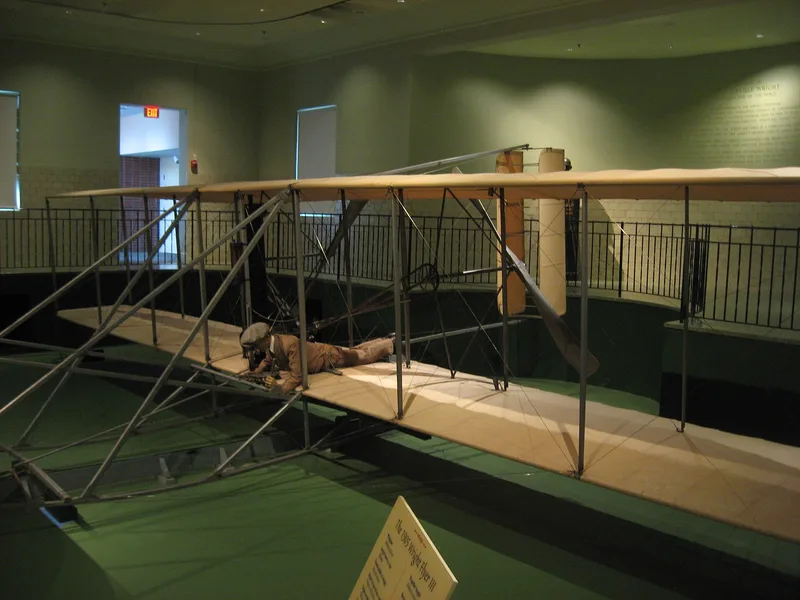
Built in 1905 by Orville and Wilbur Wright, this muslin-over-wood biplane is the third of their experimental flying machines. It weighs 710 pounds, is about 28 feet long, and is powered by a twenty-horsepower engine driving twin pusher propellers. After rebuilding and redesign in 1905, including a larger, repositioned elevator and rudder, it became what the nomination calls the world's first practical airplane. On October 5, 1905, it flew more than 39 minutes. In 1908 it was refitted and flown at Kitty Hawk, where it carried both a pilot and a passenger. Decades later it was restored under Orville Wright's supervision, finished in 1950, and put on display at Carillon Park in Dayton. Documentary and oral sources indicate it retains about two-thirds of its original fabric. The nomination presents it as nationally significant for its contributions to transportation, invention and engineering.
Significance in brief: The nomination argues the Flyer III was the first airplane capable of sustained, controlled flight and suited to practical use. It could bank, turn, circle and stay aloft for more than half an hour. It is called nationally significant in transportation, invention and engineering.
Machine-generated summary. This summary was generated by a language model from the official nomination document and has not been reviewed line by line by an editor. It may contain errors. Check the source document before relying on any detail. Source: nomination document (PDF) · National Archives catalog entry. NRHP reference 90001747, listed June 21, 1990. Summary generated October 2026 (model claude-sonnet-5-5, prompt v1.0-2026-10-29, confidence medium).
Key facts
| Address | Carillon Park, 2001 S Patterson Blvd., Dayton |
|---|---|
| County | Montgomery County |
| Listed | June 21, 1990 |
| Reference number | 90001747 |
| Resource type | Structure |
| Period of significance | 1905-1908 |
| Architect / builder | Wright, Orville and Wilbur; reconstruction: Wright, Orville |
| Architectural style | OTHER: Wright Flyer |
| Areas of significance | Engineering, Transportation, Invention |
| Level of significance | National |
| National Historic Landmark | Yes, designated June 21, 1990 |
| Status (as stated in the nomination) | On display in Wright Hall at Carillon Park and restored to its 1905 appearance; the restoration retains about two-thirds of its original fabric. |
| Acreage | 0.9 |
| Coordinates | 39.72782, -84.20154 (NPS GIS) |
What listing means for this property
National Register listing is honorary: it recognises significance and does not restrict what a private owner may do without federal money or permits. It unlocks the 20% federal rehabilitation tax credit for income-producing buildings, state credits in many states, and Section 106 review when federal agencies are involved. See what listing means in practice.
General information, not legal or tax advice. Rules change; confirm with your State Historic Preservation Office or a qualified adviser.
Sources and further reading
- National Park Service, National Register of Historic Places database (snapshot May 2026), reference 90001747.
- Nomination form (PDF, National Archives) — catalog entry
- Wikipedia article (used for cross-checking only; text not reproduced here)
- Wikidata Q1973387
- This listing as JSON
Last updated October 2026. Found an error? See the editorial policy for how to report it.