Dunlap, William K., House
Also known as: Troy Club

Why it's listed
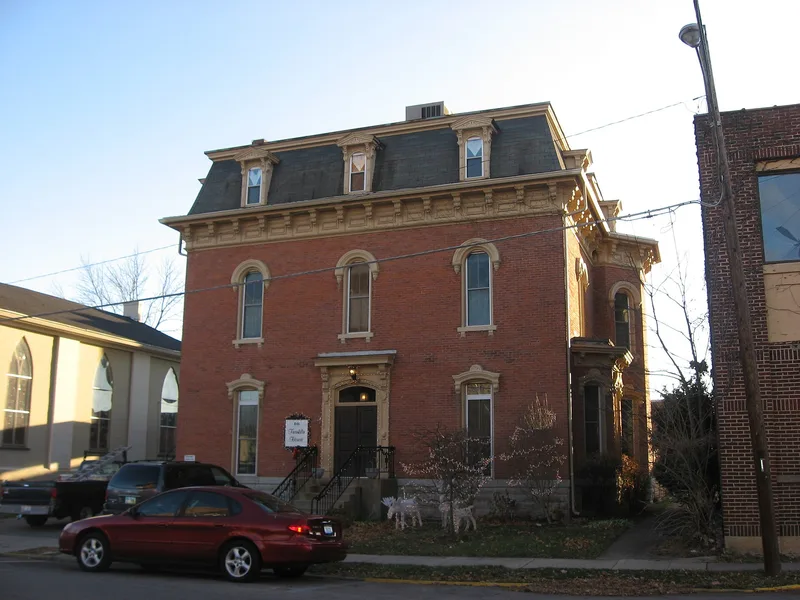
Built around 1875 at 16 East Franklin Street in Troy, Ohio, this two-story Second Empire house has a square main block with a smaller rear wing, polygonal side bays and a patterned slate mansard roof. The three-bay facade has a segmental main entrance with a bracketed Victorian frontispiece, and arched dormers with pilasters and pediments. The foundation is rock-faced stone, and the interior retains heavy moulded Victorian trim in a high state of preservation. A classic revival drive-through porch at the rear appears to be a later addition. The nomination describes the house as the best preserved and possibly the finest Second Empire building in Troy. Its first owner, William K. Dunlap, was a horticulturist whose fruit tree business sent salesmen across the Eastern states. Later owners James H. Young and George W. Scott were prominent in railroads, banking, manufacturing and civic improvement. The house stands near the commercial district and now serves as a club building.
Significance in brief: The nomination calls it the best preserved and possibly the finest example of Second Empire architecture in Troy. Its first three owners, Dunlap, James H. Young and George W. Scott, were prominent Troy businessmen and civic figures. Dunlap's nursery business reflected one of the town's major nineteenth-century industries.
Machine-generated summary. This summary was generated by a language model from the official nomination document and has not been reviewed line by line by an editor. It may contain errors. Check the source document before relying on any detail. Source: nomination document (PDF) · National Archives catalog entry. NRHP reference 76001492, listed December 12, 1976. Summary generated October 2026 (model claude-sonnet-5-5, prompt v1.0-2026-10-29, confidence high).
Key facts
| Address | 16 E. Franklin St., Troy |
|---|---|
| County | Miami County |
| Listed | December 12, 1976 |
| Reference number | 76001492 |
| Resource type | Building |
| Period of significance | c. 1875 |
| Architectural style | Second Empire |
| Areas of significance | Architecture, Agriculture |
| Level of significance | Local |
| Status (as stated in the nomination) | Occupied; described as in good condition and unaltered, and used by the Troy Club and a halfway house project. |
| Acreage | 0.9 |
| Coordinates | 40.03803, -84.20343 (NPS GIS) |
What listing means for this property
National Register listing is honorary for a privately owned home: it does not by itself restrict what an owner may do with their own money, and it does not require public access. Restrictions come from local landmark or historic-district ordinances, which are separate (how they differ).
Owner-occupied houses are not eligible for the 20% federal rehabilitation tax credit, which applies to income-producing buildings, but many states offer credits for homeowners. Listing also opens the door to preservation easements and to buying a plaque. Start with what listing means for homeowners, renovating a listed house and selling one.
General information, not legal or tax advice. Rules change; confirm with your State Historic Preservation Office or a qualified adviser.
Sources and further reading
- National Park Service, National Register of Historic Places database (snapshot May 2026), reference 76001492.
- Nomination form (PDF, National Archives) — catalog entry
- Wikidata Q138589557
- This listing as JSON
Last updated October 2026. Found an error? See the editorial policy for how to report it.