Casstown Lutheran Stone Church
Also known as: C.R. and Eunice Randall Stone House

Why it's listed
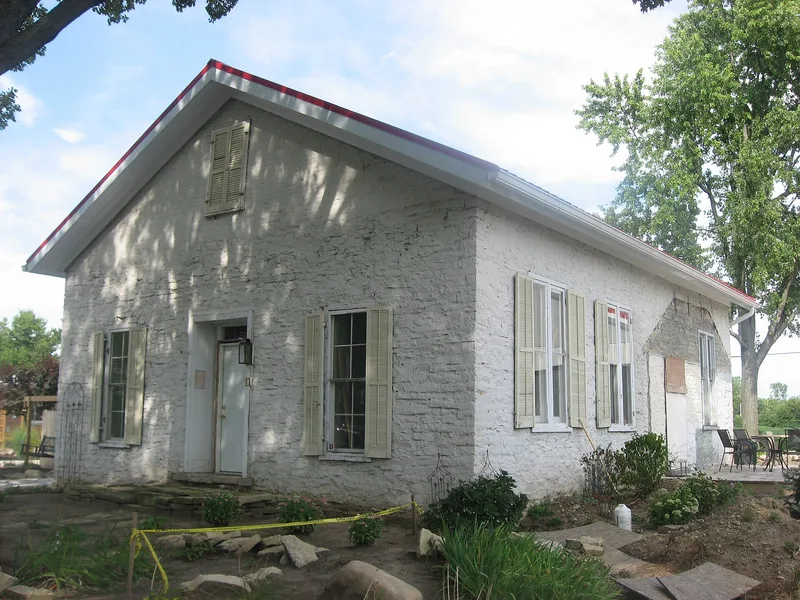
Built about 1839-40 by local people on the Daniel H. Knoop farm, this rough stone building in Casstown, Ohio, served the local Lutheran congregation until a new brick church was dedicated next door in 1868. It was then converted to a dwelling, with remodeling described as sensitive to the original features. The walls are 20 inches thick, and the interior keeps its open church space, supported by pegged chestnut and oak trusses in the attic. The same truss design appears in the 1813 John Minor Dye Stone House nearby. The church is tied to the growth of Pennsylvania German Lutheran congregations in the Miami Valley and the formation of a Western District of the Joint Synod of Lutherans of Ohio. The Knoop family, early settlers of Miami County, helped found the congregation. The building is valued for that religious history and for its unusual stone construction and structural framing.
Significance in brief: The nomination argues it marks the organization of Pennsylvania Lutheran congregations in western Ohio into a Western District of the Joint Synod of Lutherans of Ohio, and that it is one of the oldest Lutheran church buildings in the region. It is also architecturally notable for its rough stone construction and the pegged-timber truss in the attic that permits an open interior.
Machine-generated summary. This summary was generated by a language model from the official nomination document and has not been reviewed line by line by an editor. It may contain errors. Check the source document before relying on any detail. Source: nomination document (PDF) · National Archives catalog entry. NRHP reference 84003783, listed May 31, 1984. Summary generated October 2026 (model claude-sonnet-5-5, prompt v1.0-2026-10-29, confidence high).
Key facts
| Address | 11 S. Main St., Casstown |
|---|---|
| County | Miami County |
| Listed | May 31, 1984 |
| Reference number | 84003783 |
| Resource type | Building |
| Period of significance | 1800-1899 (specific dates 1839-40) |
| Criteria |
|
| Areas of significance | Architecture, Religion |
| Level of significance | Local |
| Status (as stated in the nomination) | Occupied and used as a private residence since the congregation moved to a new brick church in 1867-68; the form says it has changed little in about 115 years. |
| Acreage | 0.9 |
| Coordinates | 40.05080, -84.12883 (NPS GIS) |
What listing means for this property
Religious properties are listed for their architectural or historical significance, not their religious use. Listing is honorary and does not restrict the congregation's use of the building. The federal rehabilitation credit is generally unavailable unless part of the building is income-producing; some state programmes and preservation grants do cover religious buildings. Federal funding or permits trigger Section 106 review.
General information, not legal or tax advice. Rules change; confirm with your State Historic Preservation Office or a qualified adviser.
Sources and further reading
- National Park Service, National Register of Historic Places database (snapshot May 2026), reference 84003783.
- Nomination form (PDF, National Archives) — catalog entry
- Wikipedia article (used for cross-checking only; text not reproduced here)
- Wikidata Q5049515
- This listing as JSON
Last updated October 2026. Found an error? See the editorial policy for how to report it.