Wallischeck Homestead

Why it's listed
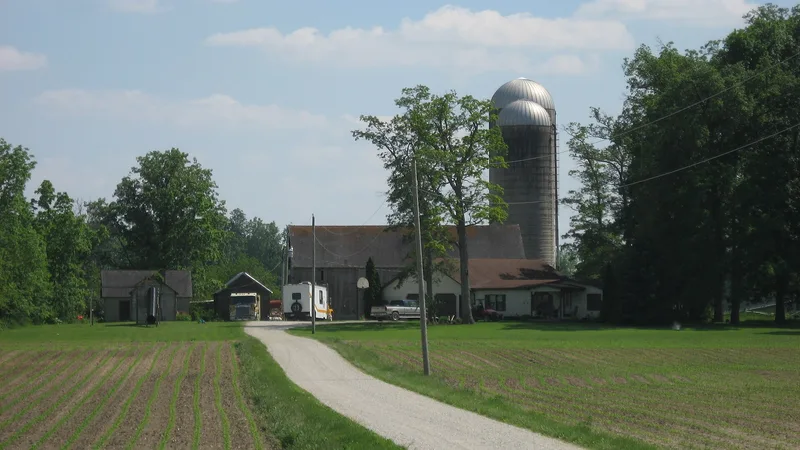
This homestead lies in woodland near Fort Recovery in Mercer County, Ohio, close to the Indiana line. Philo Wallischeck and his wife came from Baden, Germany, and settled the farm in 1855. Between 1866 and 1880 the family built the story-and-a-half brick house, using bricks made on the site. Its interior is the main point of interest: walnut woodwork cut from the farm, a wide center hall, and stencil painting applied to the rough plaster in the hall and main living room. The blue and green leaf and flower patterns and gold window outlines were never painted over. Surrounding the house are outbuildings arranged as they were used for decades, including a summer kitchen and wash house, smoke house and bake oven, brick henhouse, hand-hewn barn, and a butchering vat. The nomination describes the property as a typical turn-of-the-century farm and a good example of German vernacular building, noting that the family lived in the house for about a century without changing the interior.
Significance in brief: The nomination argues the house and support buildings represent a typical farm from the turn of the century and a 19th-century German immigrant farm complex. The house is described as an outstanding example of German vernacular architecture with rare stencilling in its original plaster. The complex shows how a homestead developed over about 100 years.
Machine-generated summary. This summary was generated by a language model from the official nomination document and has not been reviewed line by line by an editor. It may contain errors. Check the source document before relying on any detail. Source: nomination document (PDF) · National Archives catalog entry. NRHP reference 78002138, listed November 27, 1978. Summary generated October 2026 (model claude-sonnet-5-5, prompt v1.0-2026-10-29, confidence medium).
Key facts
| Address | N of Fort Recovery, Fort Recovery |
|---|---|
| County | Mercer County |
| Listed | November 27, 1978 |
| Reference number | 78002138 |
| Resource type | Building |
| Period of significance | 1800-1899 |
| Architect / builder | Philo Wallischeck |
| Architectural style | German vernacular |
| Areas of significance | Art, Architecture |
| Level of significance | State |
| Status (as stated in the nomination) | Occupied at the time of nomination by the last family member, with a note that the property would become vacant and vulnerable when she left. The house had no running water, bathroom or furnace, though it had electricity. |
| Acreage | 18 |
| Coordinates | 40.44437, -84.80149 (NPS GIS) |
What listing means for this property
National Register listing is honorary for a privately owned home: it does not by itself restrict what an owner may do with their own money, and it does not require public access. Restrictions come from local landmark or historic-district ordinances, which are separate (how they differ).
Owner-occupied houses are not eligible for the 20% federal rehabilitation tax credit, which applies to income-producing buildings, but many states offer credits for homeowners. Listing also opens the door to preservation easements and to buying a plaque. Start with what listing means for homeowners, renovating a listed house and selling one.
General information, not legal or tax advice. Rules change; confirm with your State Historic Preservation Office or a qualified adviser.
Sources and further reading
- National Park Service, National Register of Historic Places database (snapshot May 2026), reference 78002138.
- Nomination form (PDF, National Archives) — catalog entry
- Wikipedia article (used for cross-checking only; text not reproduced here)
- Wikidata Q7963150
- This listing as JSON
Last updated October 2026. Found an error? See the editorial policy for how to report it.