Damascus Grade School
Also known as: Damascus Schoolhouse; Damascus Grade School Museum

Why it's listed
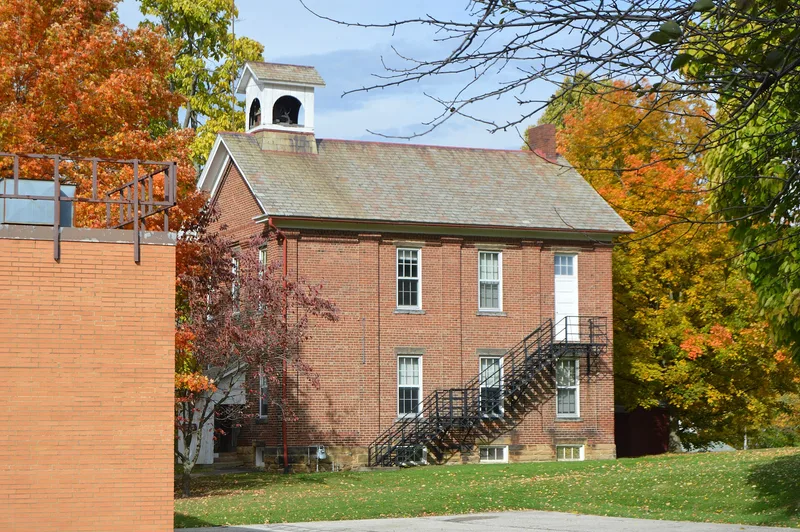
Built in 1902 by the Goshen Township school board, this two-story brick schoolhouse in Damascus, Ohio, measures 41 by 30 feet and rests on a cut sandstone foundation. Brick pilasters divide the facades into bays, the rear wall carries a raised Roman cross in brick, and the slate gable roof holds a belfry with the original 300-pound bell. Inside, oak floors, wainscoting, slate blackboards and a pressed metal ceiling survive. Damascus was settled by Quakers in 1806, and the school's plain design, with simple cornice returns, resembles earlier Quaker meeting houses and the 1857 Damascus Academy rather than turn-of-the-century school plans. It is also considered the most intact early two-room school in Mahoning County, where few remained by 1947. The school closed in 1949, later served as a house, and was bought by the Damascus Area Historical Society in 1983, which operates it as a museum. Two wood privies on the grounds contribute to the setting.
Significance in brief: The nomination argues it is significant under Criterion C for architecture. It is the best-preserved early two-room schoolhouse in the county. Its conservative design echoes earlier Quaker meeting houses and the 1857 Damascus Academy rather than contemporary school designs, reflecting the lasting influence of Damascus's Quaker heritage.
Machine-generated summary. This summary was generated by a language model from the official nomination document and has not been reviewed line by line by an editor. It may contain errors. Check the source document before relying on any detail. Source: nomination document (PDF) · National Archives catalog entry. NRHP reference 89001456, listed September 21, 1989. Summary generated October 2026 (model claude-sonnet-5-5, prompt v1.0-2026-10-29, confidence high).
Key facts
| Address | 14923 Morris St., Damascus |
|---|---|
| County | Mahoning County |
| Listed | September 21, 1989 |
| Reference number | 89001456 |
| Resource type | Building |
| Period of significance | 1902 |
| Architect / builder | Cameron, H.E. (architect/carpenter); Borton, Samuel (mason) |
| Architectural style | Late 19th and 20th century revivals |
| Criteria |
|
| Areas of significance | Architecture |
| Level of significance | Local |
| Status (as stated in the nomination) | Abandoned as a school in 1949 and used as a house until sold to the Damascus Area Historical Society in 1983; now used as a museum. |
| Acreage | 0.9 |
| Coordinates | 40.90253, -80.95446 (NPS GIS) |
What listing means for this property
For a publicly owned building or structure, listing mainly matters when federal funds, permits or licences are involved: projects then go through Section 106 review so effects on the property are considered. Listing also strengthens applications for preservation grants and, for leased income-producing uses, can enable the federal rehabilitation tax credit.
General information, not legal or tax advice. Rules change; confirm with your State Historic Preservation Office or a qualified adviser.
Sources and further reading
- National Park Service, National Register of Historic Places database (snapshot May 2026), reference 89001456.
- Nomination form (PDF, National Archives) — catalog entry
- Wikidata Q138562091
- This listing as JSON
Last updated October 2026. Found an error? See the editorial policy for how to report it.