Secor, Joseph K., House

Why it's listed
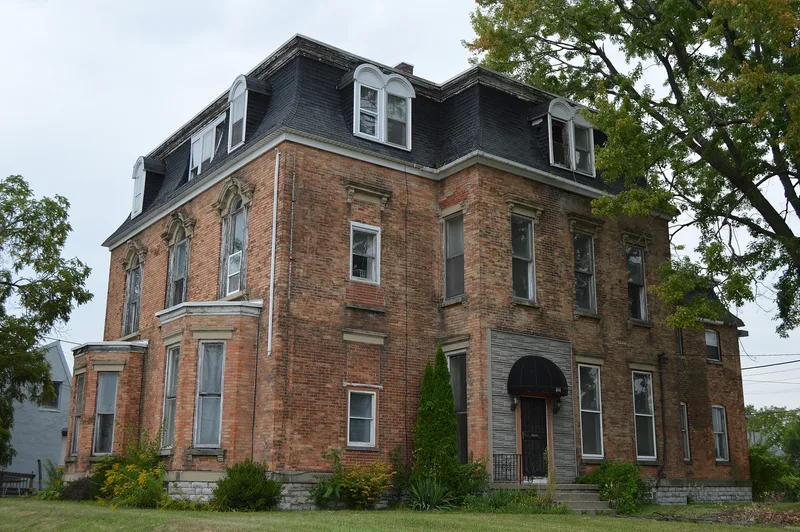
Built in 1869-70 on a park-like lot above the Maumee River, this three-story brick house at 311 Bush Street in Toledo reflects the Second French Empire style, with a bell-cast mansard roof, rounded dormers, bay windows and stone hood moldings. It was the home of Joseph K. Secor, who arrived in Toledo in 1840 and rose from grocery clerk to partner in a leading wholesale grocery firm. He helped found the First National Bank of Toledo, served on the city council and took part in several civic organizations. He and his wife, Elizabeth, were Quakers who held meetings in the house. After her death in 1911, the home became apartments, and the lot was subdivided and surrounded by newer buildings. The interior and exterior were altered, yet the house remains the last survivor of the large estates along Summit Street and the only residence tied to Secor. Its listing recognizes both his role in Toledo's commercial growth and its rare architectural style.
Significance in brief: It is the only remaining residence associated with Joseph K. Secor, a Toledo pioneer and founding figure of the city's business and banking community. It is also the last surviving structure on this stretch of Summit Street, once lined with large estates of prominent early families, and one of few Second French Empire houses in Toledo.
Machine-generated summary. This summary was generated by a language model from the official nomination document and has not been reviewed line by line by an editor. It may contain errors. Check the source document before relying on any detail. Source: nomination document (PDF) · National Archives catalog entry. NRHP reference 79003108, listed June 11, 1979. Summary generated October 2026 (model claude-sonnet-5-5, prompt v1.0-2026-10-29, confidence high).
Key facts
| Address | 311 Bush St., Toledo |
|---|---|
| County | Lucas County |
| Listed | June 11, 1979 |
| Reference number | 79003108 |
| Resource type | Building |
| Period of significance | 1800-1899 |
| Architectural style | Second French Empire |
| Areas of significance | Commerce, Exploration/Settlement |
| Level of significance | Local |
| Status (as stated in the nomination) | Occupied as apartments; altered with a removed porch, replaced front door, and a remodeled interior, in fair condition, with renovation under way at the time of nomination. |
| Acreage | 0.9 |
| Coordinates | 41.66170, -83.51770 (NPS GIS) |
What listing means for this property
National Register listing is honorary for a privately owned home: it does not by itself restrict what an owner may do with their own money, and it does not require public access. Restrictions come from local landmark or historic-district ordinances, which are separate (how they differ).
Owner-occupied houses are not eligible for the 20% federal rehabilitation tax credit, which applies to income-producing buildings, but many states offer credits for homeowners. Listing also opens the door to preservation easements and to buying a plaque. Start with what listing means for homeowners, renovating a listed house and selling one.
General information, not legal or tax advice. Rules change; confirm with your State Historic Preservation Office or a qualified adviser.
Sources and further reading
- National Park Service, National Register of Historic Places database (snapshot May 2026), reference 79003108.
- Nomination form (PDF, National Archives) — catalog entry
- Wikidata Q138542611
- This listing as JSON
Last updated October 2026. Found an error? See the editorial policy for how to report it.