Duane Block

Why it's listed
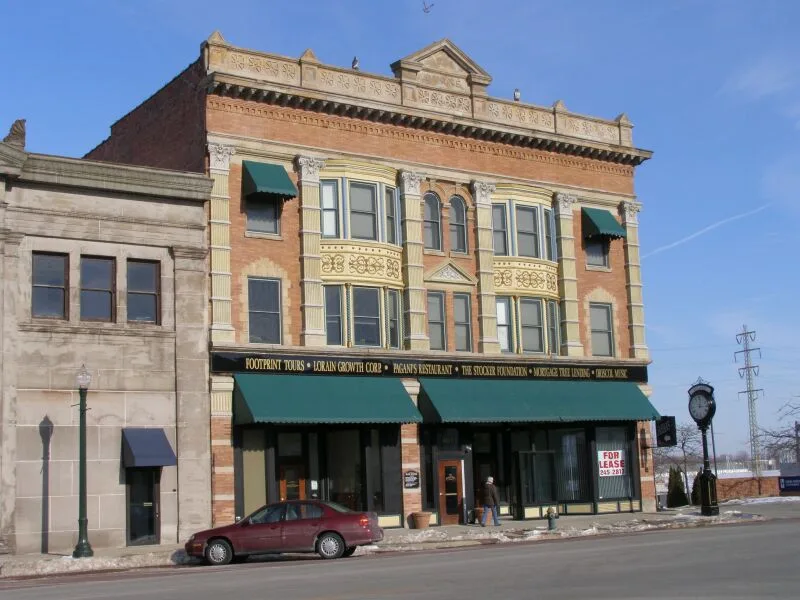
Built in 1906 on Broadway in downtown Lorain, the Duane Block combines two street-level storefronts with ten apartments on the upper floors. Its facade uses warm orange brick and local sandstone trim, with Corinthian pilasters, projecting bay windows with cast iron spandrels, and an ornate cornice. The most striking feature is an interior courtyard lit by a skylight, with a wooden staircase, tiled floor, purple marble wainscot and frosted apartment windows. Early tenants included the Metzger and Robinson Clothing Company and Bretz's Books and Music, and later Hageman Shoe and Bond Clothing. Construction cost rose from a planned $45,000 to over $50,000, reflecting wealth from the city's factories and shipyards. The building was designed by Hamilton E. Ford, whose other downtown Lorain commercial blocks have been demolished. It also survived the 1924 tornado that destroyed much of downtown. Although the storefronts have been altered, the structure remains sound and the upper floors retain their original character.
Significance in brief: The nomination argues it housed some of Lorain's leading department stores and reflects the city's turn-of-the-century industrial wealth through its elaborate design. It is also one of the few surviving works of early Lorain architect Hamilton E. Ford and one of few downtown buildings to come through the 1924 tornado relatively unscathed.
Machine-generated summary. This summary was generated by a language model from the official nomination document and has not been reviewed line by line by an editor. It may contain errors. Check the source document before relying on any detail. Source: nomination document (PDF) · National Archives catalog entry. NRHP reference 87001248, listed July 16, 1987. Summary generated October 2026 (model claude-sonnet-5-5, prompt v1.0-2026-10-29, confidence high).
Key facts
| Address | 387--401 Broadway, Lorain |
|---|---|
| County | Lorain County |
| Listed | July 16, 1987 |
| Reference number | 87001248 |
| Resource type | Building |
| Period of significance | 1900-1999 (specific date 1906) |
| Architect / builder | Hamilton E. Ford |
| Criteria |
|
| Areas of significance | Commerce, Architecture |
| Level of significance | Local |
| Status (as stated in the nomination) | Listed as occupied and in good condition, though altered; the storefronts have been marred by newer businesses and their interiors are badly damaged, while the building remains structurally sound. |
| Acreage | 0.9 |
| Within district | Broadway Historic District |
| Coordinates | 41.46743, -82.17671 (NPS GIS) |
What listing means for this property
For an income-producing building, listing (individually or as a contributing building in a district) is the gateway to the 20% federal rehabilitation tax credit on qualified rehabilitation costs, often stackable with state credits. Work claiming the credit must follow the Secretary of the Interior's Standards and be approved in advance.
Listing does not restrict a private owner acting without federal money or permits; where federal funding or licensing is involved, Section 106 review applies.
General information, not legal or tax advice. Rules change; confirm with your State Historic Preservation Office or a qualified adviser.
Sources and further reading
- National Park Service, National Register of Historic Places database (snapshot May 2026), reference 87001248.
- Nomination form (PDF, National Archives) — catalog entry
- Wikidata Q138511984
- This listing as JSON
Last updated October 2026. Found an error? See the editorial policy for how to report it.