Brownella Cottage and Grace Episcopal Church and Rectory
Also known as: Bishop Brown House; Grace Episcopal Church and Education Buil

Why it's listed
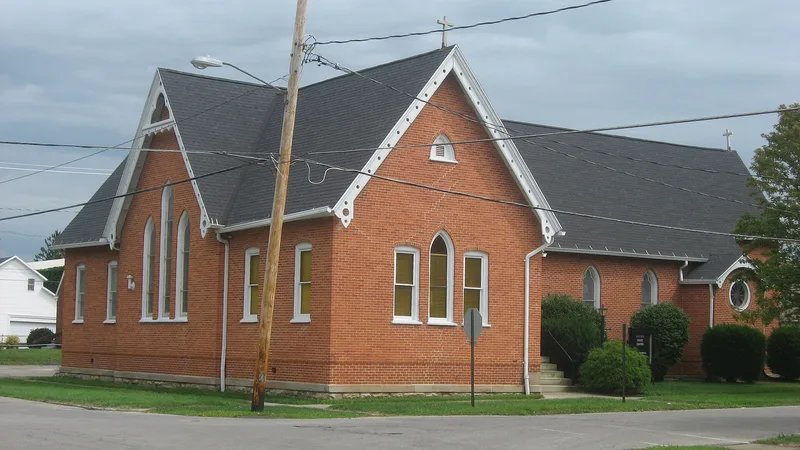
Brownella Cottage and the neighboring Grace Episcopal Church form a group of buildings in Galion, Ohio, tied to Bishop William Montgomery Brown. The brick cottage, built in 1885-1887 with money from the philanthropist Mary Scranton Bradford, has a tower, varied textures, irregular massing and decorative iron crosses set in the brickwork. A study, built in 1866 as St. Joseph's Roman Catholic Church, and a carriage house are linked to the house by glass-enclosed walkways. Across the street, Grace Episcopal Church was moved in 1893 and later covered in brick veneer, and its rectory was enlarged and veneered. Brown, a missionary in Galion and later Bishop of Arkansas, turned to Marxism and was tried for heresy in 1924-1925. He wrote and published from the study until his death in 1937, and his secretary kept distributing his works until 1959. The house stayed largely untouched until restoration began in 1979.
Significance in brief: The complex is significant for its architecture and for its link to Bishop William Montgomery Brown, an Episcopal bishop deposed for heresy in 1925 after embracing Marxism and Communism. Brownella Cottage is described as unlike any other house of its period in Galion. The church and rectory were moved and enlarged in 1893 with funds from Brown.
Machine-generated summary. This summary was generated by a language model from the official nomination document and has not been reviewed line by line by an editor. It may contain errors. Check the source document before relying on any detail. Source: nomination document (PDF) · National Archives catalog entry. NRHP reference 80002975, listed September 27, 1980. Summary generated October 2026 (model claude-sonnet-5-5, prompt v1.0-2026-10-29, confidence medium).
Key facts
| Address | S. Union and Walnut Sts., Galion |
|---|---|
| County | Crawford County |
| Listed | September 27, 1980 |
| Reference number | 80002975 |
| Resource type | Building |
| Architect / builder | Church original section designed by Lloyd and Pearce of Detroit; Brownella Cottage architect unknown |
| Architectural style | Late nineteenth-century cottage with Queen Anne features (not a pure example); Gothic-style church |
| Areas of significance | Architecture, Religion, Philosophy |
| Level of significance | National |
| Status (as stated in the nomination) | Brownella house is vacant and was nearly untouched since Brown's death in 1937; restoration began in 1979. The church is in religious use and the rectory serves as an educational building. |
| Acreage | 2 |
| Coordinates | 40.73306, -82.79102 (NPS GIS) |
What listing means for this property
Religious properties are listed for their architectural or historical significance, not their religious use. Listing is honorary and does not restrict the congregation's use of the building. The federal rehabilitation credit is generally unavailable unless part of the building is income-producing; some state programmes and preservation grants do cover religious buildings. Federal funding or permits trigger Section 106 review.
Noted as vacant in the nomination. Nomination documents can be decades old; current status may differ. If you are considering buying an empty listed property, read the due-diligence checklist.
General information, not legal or tax advice. Rules change; confirm with your State Historic Preservation Office or a qualified adviser.
Sources and further reading
- National Park Service, National Register of Historic Places database (snapshot May 2026), reference 80002975.
- Nomination form (PDF, National Archives) — catalog entry
- Wikipedia article (used for cross-checking only; text not reproduced here)
- Wikidata Q4976487
- This listing as JSON
Last updated October 2026. Found an error? See the editorial policy for how to report it.