Ikirt House

Why it's listed
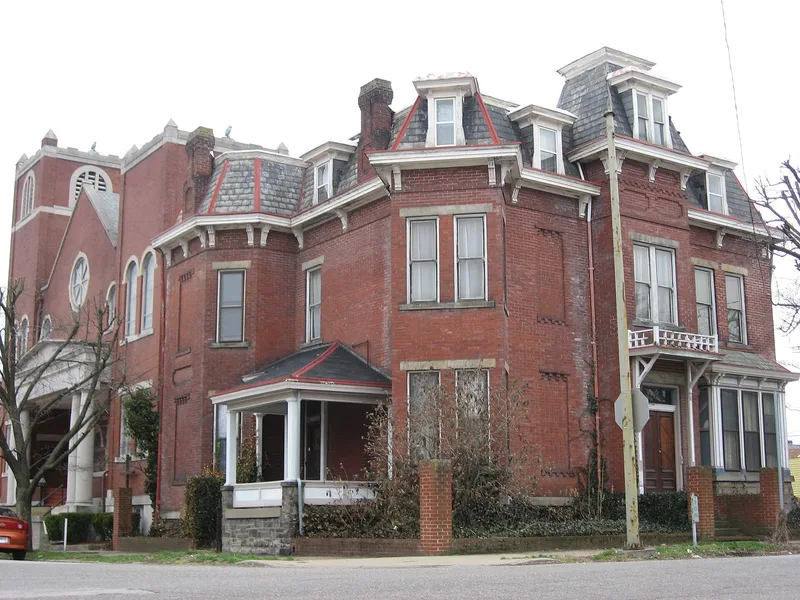
Built around 1880 at 200 Sixth Street in East Liverpool, this two-story brick house combines several late 19th-century design traditions. Its irregular bays recall the Queen Anne style, its incised brackets reflect the Eastlake mode, and its slate mansard roof comes from the Second Empire period. A square central tower marks the facade, and a small brick carriage house with its own mansard roof sits to the west. Inside, fluted walnut woodwork with corner rosettes and the original gas and plumbing fixtures remain. The house was the home of Dr. George P. Ikirt, a physician and surgeon who founded a Democratic newspaper in 1884, ran against William McKinley in 1888 and served in the 53rd Congress from 1892 to 1895. His wife, Mary Holmes Ikirt, a trained musician, belonged to numerous civic and women's organizations. The couple lived there until their deaths in the late 1920s, and their children stayed until 1974.
Significance in brief: The nomination argues the house embodies the eclectic architecture of the late 19th century, blending Queen Anne massing, Eastlake decoration and a Second Empire mansard roof. It is also tied to Dr. George P. Ikirt, a physician, Democratic political figure and congressman, and to his wife Mary Holmes Ikirt, who was active in many civic, literary, religious and women's clubs. Original interior woodwork and fixtures survive.
Machine-generated summary. This summary was generated by a language model from the official nomination document and has not been reviewed line by line by an editor. It may contain errors. Check the source document before relying on any detail. Source: nomination document (PDF) · National Archives catalog entry. NRHP reference 80002964, listed May 29, 1980. Summary generated October 2026 (model claude-sonnet-5-5, prompt v1.0-2026-10-29, confidence high).
Key facts
| Address | 200 6th St., East Liverpool |
|---|---|
| County | Columbiana County |
| Listed | May 29, 1980 |
| Reference number | 80002964 |
| Resource type | Building |
| Architectural style | Eclectic late 19th century, combining Queen Anne, Eastlake and Second Empire elements |
| Areas of significance | Politics/Government, Architecture, Social History |
| Level of significance | Local |
| Status (as stated in the nomination) | Listed as in good condition, unaltered and on its original site, in private ownership and use as a private residence, with work in progress noted. |
| Acreage | 0.9 |
| Within district | East Liverpool Downtown Historic District |
| Coordinates | 40.62072, -80.58151 (NPS GIS) |
What listing means for this property
National Register listing is honorary for a privately owned home: it does not by itself restrict what an owner may do with their own money, and it does not require public access. Restrictions come from local landmark or historic-district ordinances, which are separate (how they differ).
Owner-occupied houses are not eligible for the 20% federal rehabilitation tax credit, which applies to income-producing buildings, but many states offer credits for homeowners. Listing also opens the door to preservation easements and to buying a plaque. Start with what listing means for homeowners, renovating a listed house and selling one.
General information, not legal or tax advice. Rules change; confirm with your State Historic Preservation Office or a qualified adviser.
Sources and further reading
- National Park Service, National Register of Historic Places database (snapshot May 2026), reference 80002964.
- Nomination form (PDF, National Archives) — catalog entry
- Wikipedia article (used for cross-checking only; text not reproduced here)
- Wikidata Q5995989
- This listing as JSON
Last updated October 2026. Found an error? See the editorial policy for how to report it.