Augspurger, Frederick, Farm
Also known as: But-302-4

Why it's listed
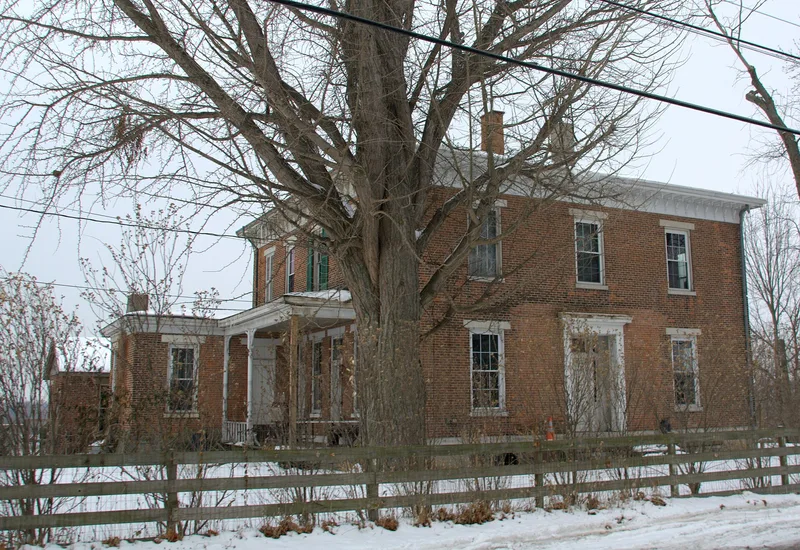
This brick farmhouse on Wayne-Madison Road in Madison Township, near Trenton, was built around 1865-70 by Frederick Augspurger, son of Christian Augspurger, a leader of the Amish and Mennonite settlement in Butler County. The two-story house has a squarish plan, a truncated hip roof, three bays across the front and a central doorway with transom and sidelights. A porch on the north side shelters two doorways and connects to a one-story kitchen. Brackets decorate the boxed cornice, and three internal chimneys rise above the roof. A bank barn, smoke house and summer kitchen remain on the farm. The land was bought by Christian Augspurger in 1847 and passed to Frederick in 1849. Frederick was a large stockholder in the Beckett Paper Company, founded in Woodsdale in 1867. The farm left Mennonite ownership by 1899. It was listed as part of a group of related Augspurger farms, with local significance.
Significance in brief: The farm is part of a thematic group tied to the Amish and Mennonite settlement of Butler County begun by Christian Augspurger. Frederick Augspurger, Christian's son, built the house and held a large stake in the Beckett Paper Company. The reviewer judged it locally significant, with the barn, smoke house and summer kitchen adding to its importance.
Machine-generated summary. This summary was generated by a language model from the official nomination document and has not been reviewed line by line by an editor. It may contain errors. Check the source document before relying on any detail. Source: nomination document (PDF) · National Archives catalog entry. NRHP reference 84002900, listed August 3, 1984. Summary generated October 2026 (model claude-sonnet-5-5, prompt v1.0-2026-10-29, confidence medium).
Key facts
| Address | 1856 Wayne-Madison Rd., Trenton |
|---|---|
| County | Butler County |
| Listed | August 3, 1984 |
| Reference number | 84002900 |
| Resource type | Building |
| Architect / builder | Frederick Augspurger (builder/owner) |
| Architectural style | Amish, Mennonite house type |
| Criteria |
|
| Areas of significance | Exploration/Settlement, Architecture |
| Level of significance | Local |
| Status (as stated in the nomination) | Inventory lists house interior and exterior condition as poor; the land is noted as zoned for industry, and the property is marked endangered. Bank barn, smoke house and summer kitchen still stand. |
| Acreage | 1 |
| Coordinates | 39.43829, -84.47620 (NPS GIS) |
What listing means for this property
National Register listing is honorary for a privately owned home: it does not by itself restrict what an owner may do with their own money, and it does not require public access. Restrictions come from local landmark or historic-district ordinances, which are separate (how they differ).
Owner-occupied houses are not eligible for the 20% federal rehabilitation tax credit, which applies to income-producing buildings, but many states offer credits for homeowners. Listing also opens the door to preservation easements and to buying a plaque. Start with what listing means for homeowners, renovating a listed house and selling one.
General information, not legal or tax advice. Rules change; confirm with your State Historic Preservation Office or a qualified adviser.
Sources and further reading
- National Park Service, National Register of Historic Places database (snapshot May 2026), reference 84002900.
- Nomination form (PDF, National Archives) — catalog entry
- Wikipedia article (used for cross-checking only; text not reproduced here)
- Wikidata Q5497286
- This listing as JSON
Last updated October 2026. Found an error? See the editorial policy for how to report it.