Hayesville Opera House

Why it's listed
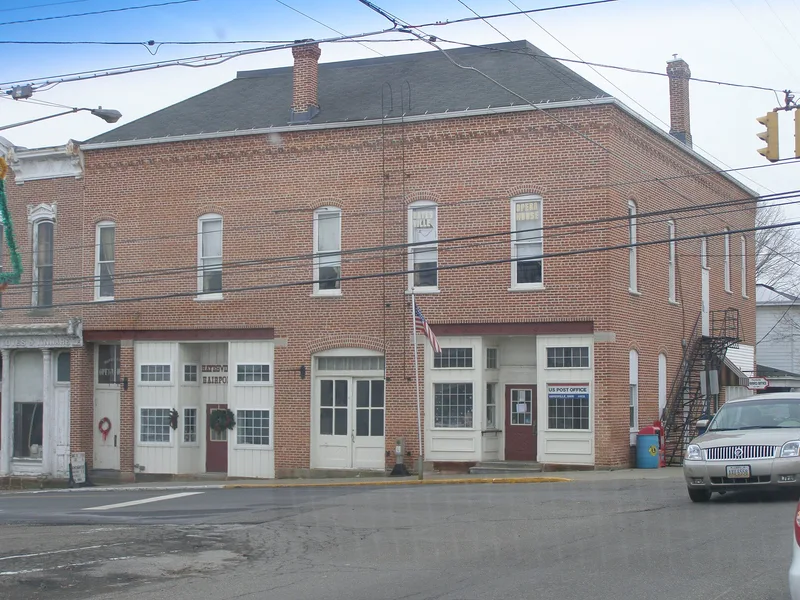
Hayesville Opera House is a nearly square, two-story brick building at 1 East Main Street in Hayesville, Ohio, opened in 1886. Shops occupy the ground floor, while the theater entrance sits at the center of the north side. The roof is hipped, and the brick cornice has simple corbelling. Inside, the theater remains close to its original state: a raked stage flanked by four gaslit dressing rooms, 350 original seats, patterned metal wainscoting and ceiling, and a large pot-bellied stove. Six painted scenery panels, one inscribed 'Sosman and Landis, Chicago, 1886', survive, which is unusual for such perishable items. Dressing room walls carry the names of plays and casts, including a note about Buffalo Bill in October 1888. The building has hosted political and church meetings, graduations, and early movie showings. It is cited as a surviving example of the small community playhouse, and village and township offices share the first floor. A restoration effort was under way when it was listed.
Significance in brief: The nomination presents it as one of a fast-disappearing type, the local lyceum or playhouse. Its stage, dressing rooms, seats, decor and heating system survive largely intact, along with six original painted scenery panels made by Sosman and Landis of Chicago in 1886. It has also served the community as a meeting place since it opened.
Machine-generated summary. This summary was generated by a language model from the official nomination document and has not been reviewed line by line by an editor. It may contain errors. Check the source document before relying on any detail. Source: nomination document (PDF) · National Archives catalog entry. NRHP reference 76001364, listed May 6, 1976. Summary generated October 2026 (model claude-sonnet-5-5, prompt v1.0-2026-10-29, confidence high).
Key facts
| Address | 1 E. Main St., Hayesville |
|---|---|
| County | Ashland County |
| Listed | May 6, 1976 |
| Reference number | 76001364 |
| Resource type | Building |
| Period of significance | 1886 |
| Architect / builder | Sosman and Landis of Chicago (scenery makers); no architect named |
| Architectural style | Vernacular, with Italianate elements |
| Areas of significance | Art, Performing Arts |
| Level of significance | Local |
| Status (as stated in the nomination) | Being restored at the time of nomination; used for plays and public meetings, with village and township offices on the first floor. A window grouping on the west side was altered around 1920. |
| Acreage | 0.9 |
| Coordinates | 40.77307, -82.26193 (NPS GIS) |
What listing means for this property
National Register listing is honorary for a privately owned home: it does not by itself restrict what an owner may do with their own money, and it does not require public access. Restrictions come from local landmark or historic-district ordinances, which are separate (how they differ).
Owner-occupied houses are not eligible for the 20% federal rehabilitation tax credit, which applies to income-producing buildings, but many states offer credits for homeowners. Listing also opens the door to preservation easements and to buying a plaque. Start with what listing means for homeowners, renovating a listed house and selling one.
General information, not legal or tax advice. Rules change; confirm with your State Historic Preservation Office or a qualified adviser.
Sources and further reading
- National Park Service, National Register of Historic Places database (snapshot May 2026), reference 76001364.
- Nomination form (PDF, National Archives) — catalog entry
- Wikidata Q81359405
- This listing as JSON
Last updated October 2026. Found an error? See the editorial policy for how to report it.