Black, Philip J., House

Approximate location: the National Park Service places this pin arbitrarily within the property, not at a surveyed point (stated accuracy ±12 m).
Why it's listed
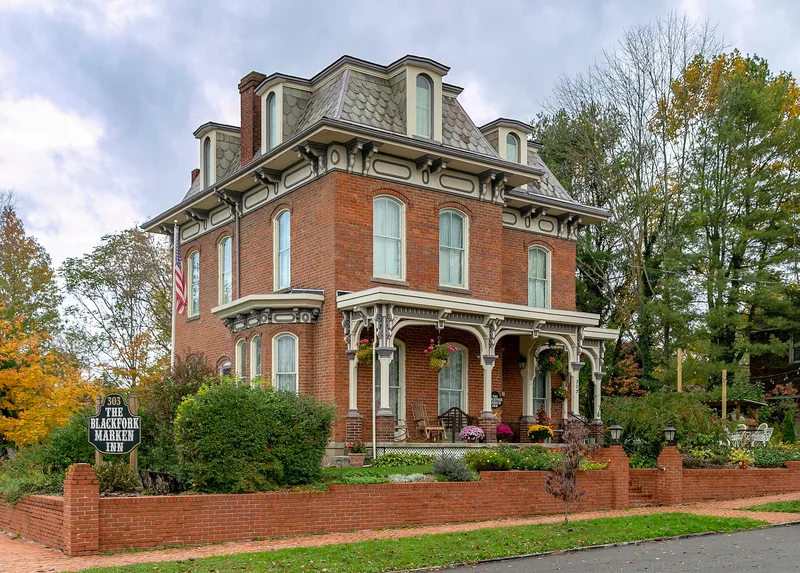
Built about 1865, this brick house at 303 North Water Street in Loudonville is a Second Empire residence with a bell-cast mansard roof, dormers, a bracketed wood cornice and a broad front porch with carved columns. Window openings have cut stone sills and segmental arches with corbelled brickwork, and the house rests on a cut sandstone foundation. Inside, there is no central hall; three parlors and a kitchen connect through broad archways, and a bay window in the southeast parlor is framed by an ogee arch. It was built for Philip J. Black, who bought the land in 1860, sold his grocery and baking business, and became a successful produce dealer, councilman and mayor. The house stayed in his family until 1944. It is one of Loudonville's largest homes and its only surviving Second Empire example. At the time of listing, restoration was under way to turn it into an inn and restaurant.
Significance in brief: The nomination argues the house is a rare, well-preserved example of Second Empire architecture and the only surviving example of that style in Loudonville. It is also one of the town's largest residences, and its size, scale and craftsmanship set it apart from other buildings of the period. Of secondary importance is its link to Black, a leading local businessman who served as mayor.
Machine-generated summary. This summary was generated by a language model from the official nomination document and has not been reviewed line by line by an editor. It may contain errors. Check the source document before relying on any detail. Source: nomination document (PDF) · National Archives catalog entry. NRHP reference 80002935, listed May 29, 1980. Summary generated October 2026 (model claude-sonnet-5-5, prompt v1.0-2026-10-29, confidence medium).
Key facts
| Address | 303 N. Water St., Loudonville |
|---|---|
| County | Ashland County |
| Listed | May 29, 1980 |
| Reference number | 80002935 |
| Resource type | Building |
| Period of significance | 1800-1899 (specific date c. 1865) |
| Architectural style | Second Empire |
| Areas of significance | Architecture |
| Level of significance | Local |
| Status (as stated in the nomination) | Excellent condition but altered; restoration in progress, with plans to convert it into a hotel and restaurant (inn). |
| Acreage | 0.9 |
| Coordinates | 40.63829, -82.23506 (NPS GIS) |
What listing means for this property
National Register listing is honorary for a privately owned home: it does not by itself restrict what an owner may do with their own money, and it does not require public access. Restrictions come from local landmark or historic-district ordinances, which are separate (how they differ).
Owner-occupied houses are not eligible for the 20% federal rehabilitation tax credit, which applies to income-producing buildings, but many states offer credits for homeowners. Listing also opens the door to preservation easements and to buying a plaque. Start with what listing means for homeowners, renovating a listed house and selling one.
General information, not legal or tax advice. Rules change; confirm with your State Historic Preservation Office or a qualified adviser.
Sources and further reading
- National Park Service, National Register of Historic Places database (snapshot May 2026), reference 80002935.
- Nomination form (PDF, National Archives) — catalog entry
- Wikidata Q137594017
- This listing as JSON
Last updated October 2026. Found an error? See the editorial policy for how to report it.