Wilson Central Business-Tobacco Warehouse Historic District
Also known as: See Also:78001986; 79001765; 82003531

Why it's listed
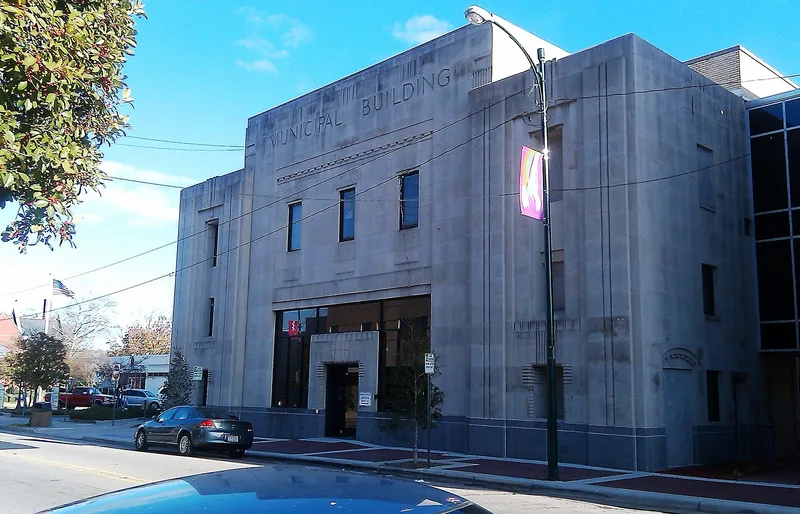
Downtown Wilson, in the upper coastal plain of eastern North Carolina, is covered by a district of thirty-six blocks that divides into four linked areas. The main business area centers on Nash and Goldsboro streets, where Neo-Classical Revival buildings such as the 1903 Branch Banking Building and the 1924 Wilson County Courthouse occupy the corners. Across the railroad tracks, the 400 and 500 blocks of East Nash Street served as the business district for East Wilson's large Black community, anchored by Jackson Chapel First Baptist Church (1913) and St. John's African Methodist Episcopal Church (1915). A third section holds eight surviving tobacco auction warehouses, with broad roofs and thousands of raised skylights. The fourth section, along the railroad, contains prize houses, redrying plants, stemmeries, the Imperial Tobacco Company plant, cotton oil seed company buildings, and a small mill village. Together these areas supported and profited from the city's growth in the early twentieth century.
Significance in brief: The nomination presents the district as the core of Wilson's commercial and tobacco-related growth, especially during the early twentieth-century boom years. Its four connected sections held the public buildings and banks, a neighborhood business district for the Black community, the tobacco auction warehouses, and the tobacco and cotton processing plants. The text available does not include the formal significance statement, so criteria and dates are not given.
Machine-generated summary. This summary was generated by a language model from the official nomination document and has not been reviewed line by line by an editor. It may contain errors. Check the source document before relying on any detail. Source: nomination document (PDF) · National Archives catalog entry. NRHP reference 84003876, listed December 20, 1984. Summary generated October 2026 (model claude-sonnet-5-5, prompt v1.0-2026-10-29, confidence medium).
Key facts
| Address | Roughly bounded by Pender, Green, Pine, S. Jackson, and Hines Sts., Wilson |
|---|---|
| County | Wilson County |
| Listed | December 20, 1984 |
| Reference number | 84003876 |
| Resource type | District |
| Architectural style | Neo-Classical Revival for the main downtown landmarks; the district also includes early twentieth-century brick commercial buildings, churches, and large tobacco warehouses |
| Areas of significance | Industry, Commerce, Agriculture, Economics, Education, Politics/Government, Architecture |
| Level of significance | Local |
| Status (as stated in the nomination) | Mixed condition; the form marks the district as occupied, deteriorated and altered. Some individual buildings, such as the Perry Building at 118 East Barnes Street, have been vacant and deteriorating. |
| Acreage | 141 |
| Coordinates | 35.72520, -77.91017 (NPS GIS) |
What listing means for this property
This is a historic district. Buildings within its boundary are either contributing (they add to the district's significance) or non-contributing. Owners of contributing income-producing buildings can claim the 20% federal rehabilitation tax credit; homeowners should look at state credits. National Register districts impose no design review by themselves; a local historic district ordinance, if one exists, does (the difference explained).
General information, not legal or tax advice. Rules change; confirm with your State Historic Preservation Office or a qualified adviser.
Sources and further reading
- National Park Service, National Register of Historic Places database (snapshot May 2026), reference 84003876.
- Nomination form (PDF, National Archives) — catalog entry
- Wikipedia article (used for cross-checking only; text not reproduced here)
- Wikidata Q22061148
- This listing as JSON
Last updated October 2026. Found an error? See the editorial policy for how to report it.