St. Paul's Episcopal Church and Cemetery
St. Paul's Episcopal Church and Cemetery is a building in Wilkesboro, Wilkes County, North Carolina, listed on the National Register of Historic Places on October 19, 1982 (reference number 82001308). The National Park Service records its significance in Architecture and Religion at the local level.
Facts from the NPS National Register database (); nomination summary October 2026. Last updated . Sources for each fact.

Approximate location: the National Park Service places this pin arbitrarily within the property, not at a surveyed point (stated accuracy ±12 m).
Why it's listed
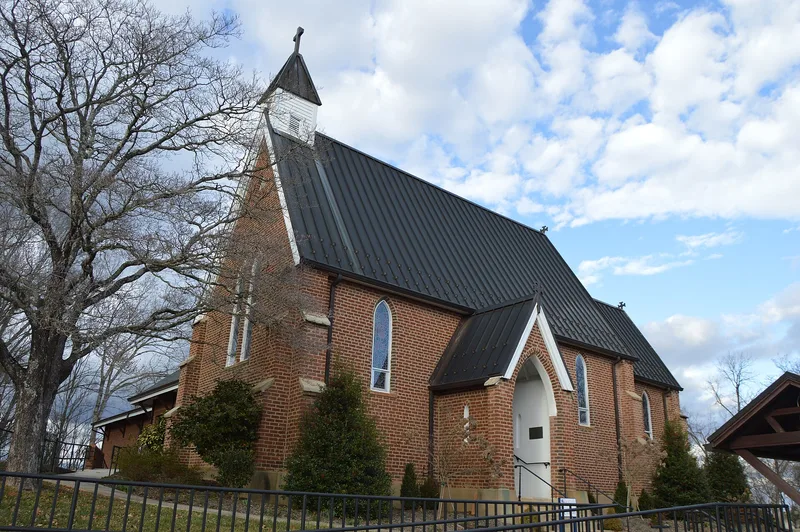
Set on the crest of a hill above Wilkesboro, this small brick church and its cemetery date to 1848-1849, when local builder D. Dameron constructed the building for a young Episcopal congregation formed in 1836. Its steep gable roof, stepped corner buttresses and lancet windows recall English country parish churches. Inside, a trussed-rafter ceiling, grained pulpit and font, and walnut pews survive largely original. The north wall was rebuilt after a windstorm in 1928. Bishop Levi Silliman Ives consecrated the church in July 1849, one of the earliest consecrations in what is now the Diocese of Western North Carolina, and he praised it as a beautiful Gothic structure built at small expense and without debt. The church is among the few buildings left from Wilkesboro's years before the Civil War. The adjoining cemetery holds members of local families such as the Gordons, Calloways, Barbers and Wellborns.
Significance in brief: The church marked a significant extension of the Protestant Episcopal Church into northwestern North Carolina, and its 1849 consecration was one of the earliest in what is now the Diocese of Western North Carolina. It is one of the few remaining buildings tied to the pre-Civil War development of Wilkesboro. It is also a well-preserved example of mid-nineteenth century Gothic Revival design in a small brick parish church.
Machine-generated summary. This summary was generated by a language model from the official nomination document and has not been reviewed line by line by an editor. It may contain errors. Check the source document before relying on any detail. Source: nomination document (PDF) · National Archives catalog entry. NRHP reference 82001308, listed October 19, 1982. Summary generated October 2026 (model claude-sonnet-5-5, prompt v1.0-2026-10-29, confidence high).
Key facts
| Official database NPS National Register database, ref. 82001308 , checked | |
|---|---|
| Address | Cowles St. between Woodland Blvd. and West St., Wilkesboro |
| County | Wilkes County |
| Listed | October 19, 1982 |
| Reference number | 82001308 |
| Resource type | Building |
| Areas of significance | Architecture, Religion |
| Level of significance | Local |
| National Historic Landmark | No |
| Acreage | 2.8 |
| Official document, machine-extracted Nomination form (National Archives) , checked | |
| Period of significance | 1848-1849 |
| Architect / builder | D. Dameron |
| Architectural style | Gothic Revival |
| Criteria |
|
| Status (as stated in the nomination) | Occupied and in use as a religious property; the form describes the church as little altered, with the north wall rebuilt after a 1928 windstorm. |
| Official dataset NPS cultural-resource GIS (NRHP locations) | |
| Coordinates | 36.14936, -81.15488 |
What listing means for this property
Religious properties are listed for their architectural or historical significance, not their religious use. Listing is honorary and does not restrict the congregation's use of the building. The federal rehabilitation credit is generally unavailable unless part of the building is income-producing; some state programmes and preservation grants do cover religious buildings. Federal funding or permits trigger Section 106 review.
General information, not legal or tax advice. Rules change; confirm with your State Historic Preservation Office or a qualified adviser.
Questions about St. Paul's Episcopal Church and Cemetery
When was St. Paul's Episcopal Church and Cemetery added to the National Register of Historic Places?
St. Paul's Episcopal Church and Cemetery was listed on October 19, 1982. Its National Register reference number is 82001308.
Is St. Paul's Episcopal Church and Cemetery a National Historic Landmark?
No. The National Park Service database (snapshot of May 2026) lists St. Paul's Episcopal Church and Cemetery on the National Register but does not record it as a National Historic Landmark.
Where is St. Paul's Episcopal Church and Cemetery?
Cowles St. between Woodland Blvd. and West St., Wilkesboro, Wilkes County, North Carolina; coordinates 36.14936, -81.15488.
Why is St. Paul's Episcopal Church and Cemetery historically significant?
According to a machine-generated summary of its nomination form: The church marked a significant extension of the Protestant Episcopal Church into northwestern North Carolina, and its 1849 consecration was one of the earliest in what is now the Diocese of Western North Carolina. It is one of the few remaining buildings tied to the pre-Civil War development of Wilkesboro. It is also a well-preserved example of mid-nineteenth century Gothic Revival design in a small brick parish church. Check the nomination document before relying on any detail.
Who designed or built St. Paul's Episcopal Church and Cemetery?
The nomination form names D. Dameron as architect or builder (extracted by machine from the nomination; check the source document).
Where can I read the original nomination for St. Paul's Episcopal Church and Cemetery?
The nomination form is a public record held by the National Archives: nomination document (PDF).
Sources and further reading
- National Park Service, National Register of Historic Places database (snapshot May 2026), reference 82001308.
- Nomination form (PDF, National Archives) — catalog entry
- Wikipedia article (used for cross-checking only; text not reproduced here)
- Wikidata Q7591134
- This listing as JSON
Last updated November 2026. Found an error? See the editorial policy for how to report it.