Claymont Hill
Also known as: Albert L. Hendrix House

Why it's listed
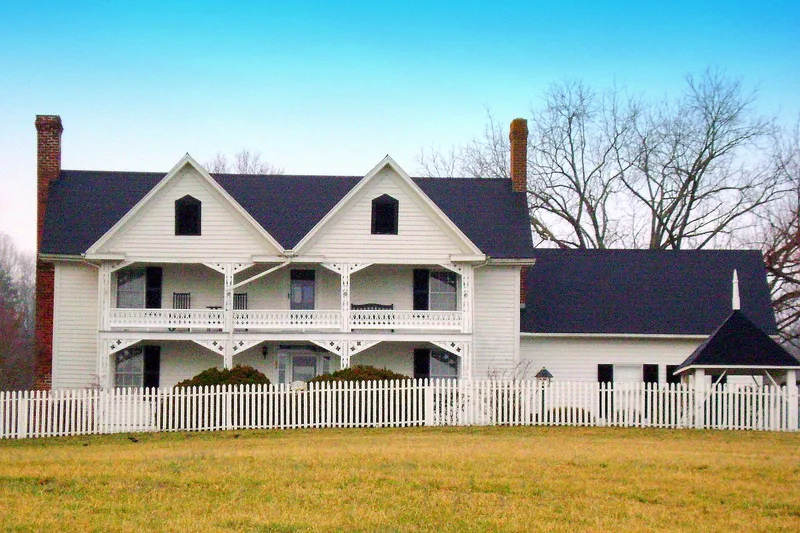
Claymont Hill is a farmhouse above the Yadkin River just south of Ronda in Wilkes County, North Carolina. Albert L. Hendrix built it in 1870, enclosing an early nineteenth-century log house that may have belonged to John Martin or his son Isaac. The two-story, center-hall house has a rear ell, two-story porches on three sides, pointed gable vents, and sawnwork trim that give it a Carpenter Gothic character. Ten outbuildings survive, including a small log kitchen thought to predate the house, and a Martin family cemetery lies nearby. Hendrix was a farmer, merchant and Justice of the Peace who had served in the General Assembly. His son W. A. Hendrix bought the farm back in 1909 and served as Ronda postmaster, revenue officer and deputy U.S. marshal. The house was redecorated that year, including grained woodwork. The property was listed for its architecture, for these two men, and for its likely archaeological potential.
Significance in brief: The nomination argues the house is a vernacular Gothic farmhouse that incorporates an earlier log structure, with a surviving group of outbuildings including a log kitchen. It is also tied to A. L. Hendrix and his son W. A. Hendrix, who were prominent local figures. The site may also hold archaeological resources.
Machine-generated summary. This summary was generated by a language model from the official nomination document and has not been reviewed line by line by an editor. It may contain errors. Check the source document before relying on any detail. Source: nomination document (PDF) · National Archives catalog entry. NRHP reference 85002369, listed September 12, 1985. Summary generated October 2026 (model claude-sonnet-5-5, prompt v1.0-2026-10-29, confidence high).
Key facts
| Address | W side of SR 2303 along Ronda-Clingman Rd., Ronda |
|---|---|
| County | Wilkes County |
| Listed | September 12, 1985 |
| Reference number | 85002369 |
| Resource type | Building |
| Period of significance | 1800-1899, 1900- |
| Architect / builder | Unknown |
| Architectural style | Vernacular Gothic farmhouse with Carpenter Gothic flavor |
| Criteria |
|
| Areas of significance | Law, Politics/Government, Architecture |
| Level of significance | Local |
| Status (as stated in the nomination) | Occupied as a private residence and farm, with a well-tended farmstead; condition checked as altered and the owner is described as dedicated to preservation. |
| Acreage | 179.3 |
| Coordinates | 36.20732, -80.93471 (NPS GIS) |
What listing means for this property
National Register listing is honorary: it recognises significance and does not restrict what a private owner may do without federal money or permits. It unlocks the 20% federal rehabilitation tax credit for income-producing buildings, state credits in many states, and Section 106 review when federal agencies are involved. See what listing means in practice.
General information, not legal or tax advice. Rules change; confirm with your State Historic Preservation Office or a qualified adviser.
Sources and further reading
- National Park Service, National Register of Historic Places database (snapshot May 2026), reference 85002369.
- Nomination form (PDF, National Archives) — catalog entry
- Wikipedia article (used for cross-checking only; text not reproduced here)
- Wikidata Q20708748
- This listing as JSON
Last updated October 2026. Found an error? See the editorial policy for how to report it.