St. Augustine's College Campus (Additional Documentation)

Why it's listed
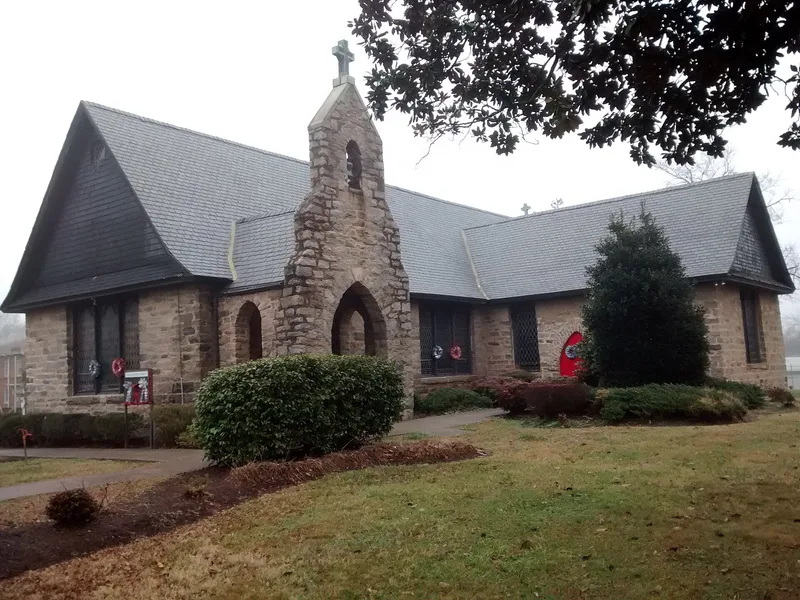
St. Augustine's College occupies a campus along Oakwood Avenue in Raleigh, North Carolina. The school was incorporated in 1867 and began instruction in January 1868 as a project of the Episcopal Church's Freedmen's Commission, training teachers for Black communities after the Civil War. A permanent site was acquired in 1868 from the Seven Springs estate, and the campus grew to 110 acres. The oldest surviving building is the stone chapel of 1895, followed by the Romanesque Revival Benson Library of 1896-98 and the stone St. Agnes Hospital completed in 1909. Brick buildings with classical revival details, including Hunter, Delaney and Cheshire, formed the central oval in the 1920s and 1930. The school moved from normal school to junior college and then full college status in 1928. It was listed for its role in Black education, its links to church leaders and early Black and women physicians, and its range of institutional architecture.
Significance in brief: The nomination presents the school as a prime example of the physical and philosophical development of Black education after the Civil War, moving from teacher training and industrial education to a liberal arts college. It also reflects the history of St. Agnes Hospital, ties to notable Episcopal bishops and early Black and women physicians, and the campus's varied institutional Gothic, Romanesque and later buildings.
Machine-generated summary. This summary was generated by a language model from the official nomination document and has not been reviewed line by line by an editor. It may contain errors. Check the source document before relying on any detail. Source: nomination document (PDF) · National Archives catalog entry. NRHP reference 80002903, listed March 28, 1980. Summary generated October 2026 (model claude-sonnet-5-5, prompt v1.0-2026-10-29, confidence medium).
Key facts
| Address | Oakwood Ave., Raleigh |
|---|---|
| County | Wake County |
| Listed | March 28, 1980 |
| Reference number | 80002903 |
| Resource type | District |
| Period of significance | 1867-1930 |
| Architectural style | Institutional Gothic and Romanesque Revival, with classical revival brick buildings and more recent styles |
| Criteria |
|
| Areas of significance | Education, Ethnic Heritage-Black |
| Level of significance | State |
| Status (as stated in the nomination) | Condition marked good; the campus is occupied and privately owned by the college. |
| Acreage | 20 |
| Coordinates | 35.78536, -78.61944 (NPS GIS) |
What listing means for this property
This is a historic district. Buildings within its boundary are either contributing (they add to the district's significance) or non-contributing. Owners of contributing income-producing buildings can claim the 20% federal rehabilitation tax credit; homeowners should look at state credits. National Register districts impose no design review by themselves; a local historic district ordinance, if one exists, does (the difference explained).
General information, not legal or tax advice. Rules change; confirm with your State Historic Preservation Office or a qualified adviser.
Sources and further reading
- National Park Service, National Register of Historic Places database (snapshot May 2026), reference 80002903.
- Nomination form (PDF, National Archives) — catalog entry
- Wikipedia article (used for cross-checking only; text not reproduced here)
- Wikidata Q7587158
- This listing as JSON
Last updated October 2026. Found an error? See the editorial policy for how to report it.