Oak View
Also known as: Williams--Wyatt--Poole Farm

Why it's listed
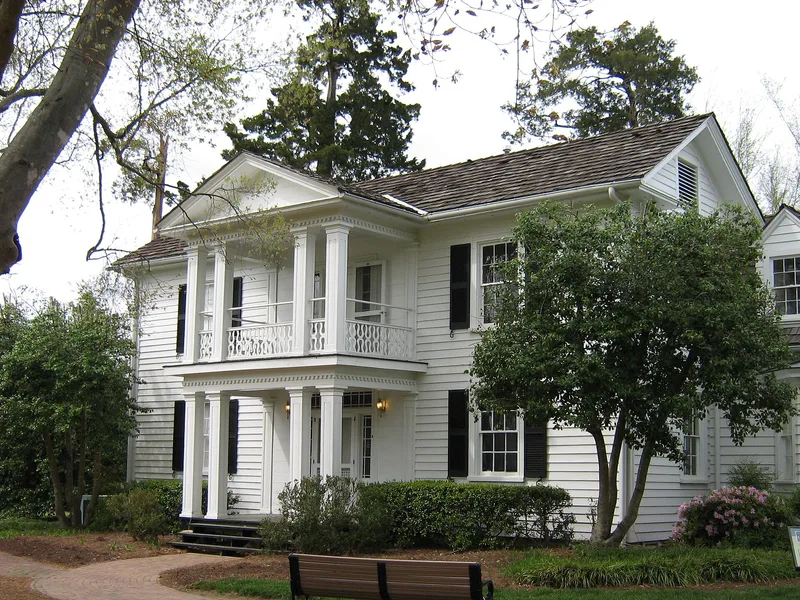
Oak View is a farm complex on a rise near the Raleigh Beltline, about four miles east of downtown Raleigh. Benton S. D. Williams bought the land in 1853 and built a frame I-house with a two-story pedimented portico around 1855. Surviving buildings include a dovetailed plank kitchen, a carriage house, a livestock barn, a cotton gin house, a water tower, a family cemetery and a large pecan grove planted in the 1910s and 1920s. The farm is significant for several reasons. It shows the move from antebellum cotton growing with enslaved labor to a later manager-run operation with wage workers. Williams served as a Wake County delegate to the 1868 Constitutional Convention. In 1940-41 the house was enlarged and modernized in Colonial Revival style for the J. Gregory Poole family while keeping its Greek Revival front. The farm once covered about 1,000 acres; 72 acres remain, owned by Wake County.
Significance in brief: The nomination argues the farm is significant in agriculture, architecture, and politics and government. It reflects Wake County's shift from antebellum cotton farming with enslaved labor to a manager-operated farm using wage labor, and it includes a pecan grove among the county's largest. The house shows the trend of remodeling older houses in Colonial Revival style, and Williams was a delegate to the 1868 Constitutional Convention.
Machine-generated summary. This summary was generated by a language model from the official nomination document and has not been reviewed line by line by an editor. It may contain errors. Check the source document before relying on any detail. Source: nomination document (PDF) · National Archives catalog entry. NRHP reference 91000359, listed April 3, 1991. Summary generated October 2026 (model claude-sonnet-5-5, prompt v1.0-2026-10-29, confidence high).
Key facts
| Address | Jct. of Poole Rd. and Raleigh Beltline, Raleigh |
|---|---|
| County | Wake County |
| Listed | April 3, 1991 |
| Reference number | 91000359 |
| Resource type | District |
| Period of significance | ca. 1853-1941 |
| Architect / builder | Williams, Benton S. D. (significant person); architect/builder unknown |
| Architectural style | Colonial Revival (Greek Revival main block, remodeled 1940-41) |
| Criteria |
|
| Areas of significance | Agriculture, Politics/Government, Architecture |
| Level of significance | Local |
| Status (as stated in the nomination) | Current function listed as vacant/not in use; the gazebo's shingles are badly deteriorated and the kitchen has termite damage. Wake County purchased the remaining 72 acres in 1983. |
| Acreage | 15 |
| Coordinates | 35.76945, -78.57200 (NPS GIS) |
What listing means for this property
This is a historic district. Buildings within its boundary are either contributing (they add to the district's significance) or non-contributing. Owners of contributing income-producing buildings can claim the 20% federal rehabilitation tax credit; homeowners should look at state credits. National Register districts impose no design review by themselves; a local historic district ordinance, if one exists, does (the difference explained).
Noted as vacant in the nomination. Nomination documents can be decades old; current status may differ. If you are considering buying an empty listed property, read the due-diligence checklist.
General information, not legal or tax advice. Rules change; confirm with your State Historic Preservation Office or a qualified adviser.
Sources and further reading
- National Park Service, National Register of Historic Places database (snapshot May 2026), reference 91000359.
- Nomination form (PDF, National Archives) — catalog entry
- Wikipedia article (used for cross-checking only; text not reproduced here)
- Wikidata Q16892325
- This listing as JSON
Last updated October 2026. Found an error? See the editorial policy for how to report it.