Falls of the Neuse Manufacturing Company
Also known as: Manteo Manufacturing Company; Forest Manufacturing Company

Why it's listed
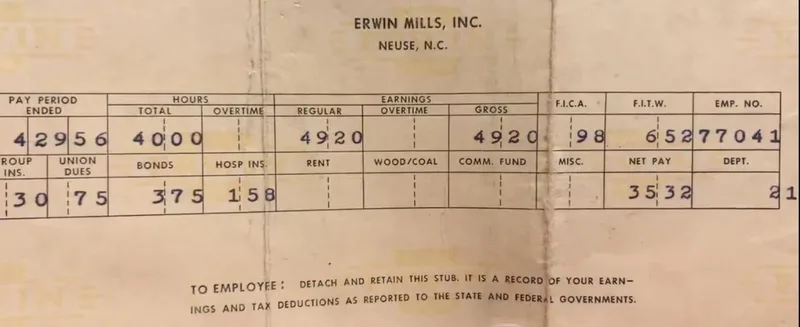
Granite buildings beside the Neuse River at Falls, Wake County, mark one of North Carolina's oldest manufacturing sites. The main mill, three stories tall and about 200 feet long, was built of local granite in 1854-1855 for the Manteo Manufacturing Company as a paper mill. A smaller one-story granite building served first as a stock room and later as a picker room. A 400-foot stone dam and a millrace supplied water power from the natural falls. From 1855 to 1896 the mill made rag paper, supplying state government and most eastern North Carolina printers under William F. Askew. A flood in 1896 wrecked the plant, and the building was remodeled for cotton processing in 1899. Textile production continued under several owners until Erwin Mills closed the plant in 1959. The building was later used as a cotton warehouse, and a 1983 owner planned to convert the granite buildings to residences.
Significance in brief: The complex stands at one of North Carolina's oldest manufacturing sites and was powered by the natural falls of the Neuse River. Its chief period of significance was its 1855-1896 operation as a paper mill, described as the only significant paper producer in eastern North Carolina and one of the largest in the state. It later operated as a cotton and synthetic yarn mill.
Machine-generated summary. This summary was generated by a language model from the official nomination document and has not been reviewed line by line by an editor. It may contain errors. Check the source document before relying on any detail. Source: nomination document (PDF) · National Archives catalog entry. NRHP reference 83001921, listed September 19, 1983. Summary generated October 2026 (model claude-sonnet-5-5, prompt v1.0-2026-10-29, confidence medium).
Key facts
| Address | Neuse River at SR 2000, Falls |
|---|---|
| County | Wake County |
| Listed | September 19, 1983 |
| Reference number | 83001921 |
| Resource type | Building |
| Period of significance | 1855-1896 |
| Areas of significance | Industry, Historic - Non-Aboriginal, Architecture |
| Level of significance | State |
| Status (as stated in the nomination) | Unoccupied at the time of nomination; last used as a cotton warehouse after Erwin Mills closed the plant in 1959. A 1983 purchaser intended to convert the granite buildings into residences. |
| Acreage | 4 |
| Coordinates | 35.93895, -78.57859 (NPS GIS) |
What listing means for this property
For an income-producing building, listing (individually or as a contributing building in a district) is the gateway to the 20% federal rehabilitation tax credit on qualified rehabilitation costs, often stackable with state credits. Work claiming the credit must follow the Secretary of the Interior's Standards and be approved in advance.
Listing does not restrict a private owner acting without federal money or permits; where federal funding or licensing is involved, Section 106 review applies.
General information, not legal or tax advice. Rules change; confirm with your State Historic Preservation Office or a qualified adviser.
Sources and further reading
- National Park Service, National Register of Historic Places database (snapshot May 2026), reference 83001921.
- Nomination form (PDF, National Archives) — catalog entry
- Wikipedia article (used for cross-checking only; text not reproduced here)
- Wikidata Q20709141
- This listing as JSON
Last updated October 2026. Found an error? See the editorial policy for how to report it.