Pool Rock Plantation

The pin is a point inside the NPS boundary polygon, not a surveyed location.
Why it's listed
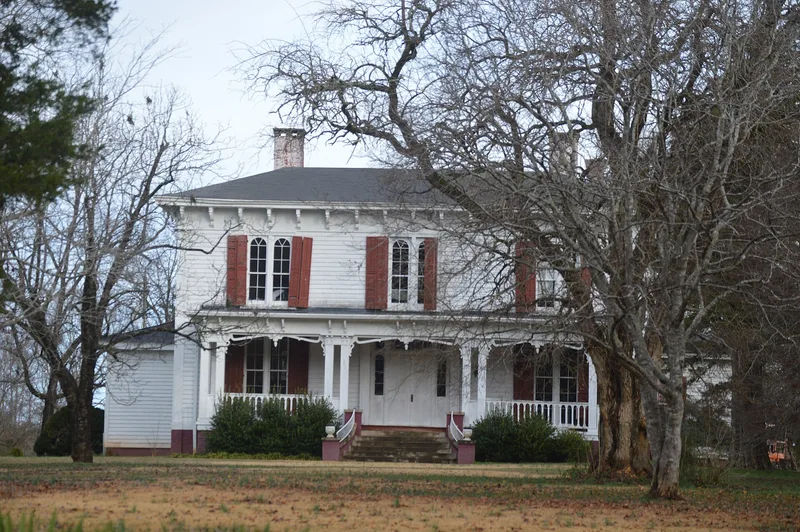
Pool Rock is a plantation house in rural Vance County, North Carolina, made up of two dwellings joined back to back by a hall. The older rear section is a two-story, gable-roofed Federal house, probably built between 1805 and 1827, with fine molded woodwork and brick chimneys. The front section, added around 1853, is a bracketed Greek Revival and Italianate house with a shallow hip roof, an ornate porch, and pinwheel tracery at the entrance. Its details closely match the work of Warrenton builder Jacob Holt, though no document confirms his involvement. The property was once part of a plantation of more than 1,400 acres and passed through the Mitchell, Lanier, Taylor, Sharp and Parker families. Its name is traditionally traced to a caretaker named Poole and a nearby rock slide. Today the house sits on about four and a half acres with an office building, a relocated log house and other outbuildings. It was listed for its link to the pre-Civil War farm economy and for its two distinct architectural periods.
Significance in brief: The nomination argues the house reflects the agrarian plantation economy of the northeastern Piedmont before the Civil War. It also embodies two architectural periods: a refined rural Federal-style dwelling and a Greco-Italianate front block with the hallmarks of Warrenton builder Jacob Holt and his workshop.
Machine-generated summary. This summary was generated by a language model from the official nomination document and has not been reviewed line by line by an editor. It may contain errors. Check the source document before relying on any detail. Source: nomination document (PDF) · National Archives catalog entry. NRHP reference 78001977, listed November 29, 1978. Summary generated October 2026 (model claude-sonnet-5-5, prompt v1.0-2026-10-29, confidence high).
Key facts
| Address | NE of Williamsboro on SR 1380, Williamsboro |
|---|---|
| County | Vance County |
| Listed | November 29, 1978 |
| Reference number | 78001977 |
| Resource type | Building |
| Period of significance | 1800-1899 |
| Architect / builder | 1850s: Jacob W. Holt? (not documented as Holt's work) |
| Architectural style | Federal (rear section) and Greek Revival/Italianate blend in the style of Jacob Holt (front section) |
| Criteria |
|
| Areas of significance | Architecture |
| Level of significance | Local |
| Status (as stated in the nomination) | Described as in good condition and occupied as a private residence; it is no longer the seat of a working farm, and restoration was still underway at the time of the form. |
| Acreage | 4.5 |
| Coordinates | 36.45429, -78.41760 (NPS GIS) |
What listing means for this property
National Register listing is honorary for a privately owned home: it does not by itself restrict what an owner may do with their own money, and it does not require public access. Restrictions come from local landmark or historic-district ordinances, which are separate (how they differ).
Owner-occupied houses are not eligible for the 20% federal rehabilitation tax credit, which applies to income-producing buildings, but many states offer credits for homeowners. Listing also opens the door to preservation easements and to buying a plaque. Start with what listing means for homeowners, renovating a listed house and selling one.
General information, not legal or tax advice. Rules change; confirm with your State Historic Preservation Office or a qualified adviser.
Sources and further reading
- National Park Service, National Register of Historic Places database (snapshot May 2026), reference 78001977.
- Nomination form (PDF, National Archives) — catalog entry
- Wikipedia article (used for cross-checking only; text not reproduced here)
- Wikidata Q19987633
- This listing as JSON
Last updated October 2026. Found an error? See the editorial policy for how to report it.