Thyatira Presbyterian Church, Cemetery, and Manse
Thyatira Presbyterian Church, Cemetery, and Manse is a building in Mill Bridge, Rowan County, North Carolina, listed on the National Register of Historic Places on February 17, 1984 (reference number 84002488). The National Park Service records its significance in Architecture and Religion at the state level.
Facts from the NPS National Register database (); nomination summary October 2026. Last updated . Sources for each fact.

The pin is a point inside the NPS boundary polygon, not a surveyed location.
Why it's listed
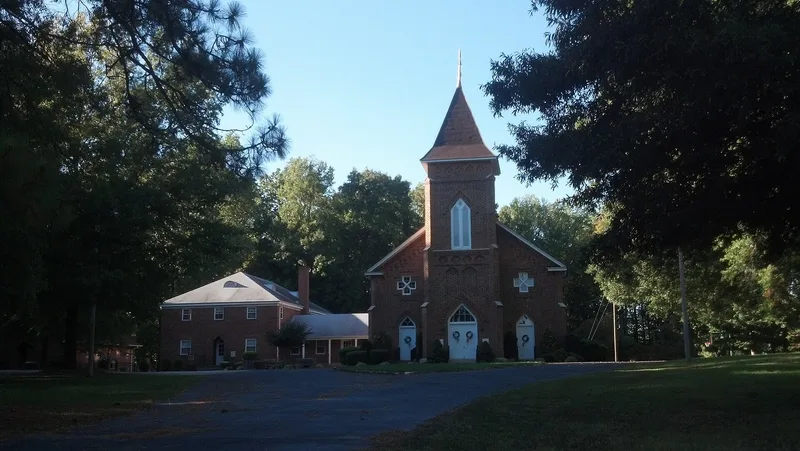
Thyatira Presbyterian Church, its cemetery and its manse form a religious complex at Mill Bridge in Rowan County, North Carolina. The congregation was organized by 1750 in what was then Cathey's Settlement, making it one of the oldest in the North Carolina piedmont. The present brick church, finished in 1860 by Salisbury builders William Murdoch and W. Raeder, is a vernacular Gothic Revival building with a three-stage tower, buttresses and unusual patterned brickwork around its doors and windows. Funding came from seventy-seven subscribers, led by the wealthy planter Dr. Samuel Kerr. The adjoining cemetery holds 18th and 19th century graves of settlers, ministers, legislators, physicians and planters, including the Rev. Samuel McCorkle and Matthew Locke. Across the road, the manse is a 1920s brick-veneered bungalow. Together the buildings reflect the community's antebellum prosperity and its long role as a social and religious center.
Significance in brief: The nomination argues the church is a rare, boldly detailed example of vernacular Gothic Revival brickwork and the culmination of the local plantation economy. The congregation dates to about 1750 in Cathey's Settlement, and the cemetery holds the graves of many prominent planters, ministers, physicians, legislators and Revolutionary-era figures. The church was built by the noted contractor William Murdoch with W. Raeder.
Machine-generated summary. This summary was generated by a language model from the official nomination document and has not been reviewed line by line by an editor. It may contain errors. Check the source document before relying on any detail. Source: nomination document (PDF) · National Archives catalog entry. NRHP reference 84002488, listed February 17, 1984. Summary generated October 2026 (model claude-sonnet-5-5, prompt v1.0-2026-10-29, confidence high).
Key facts
| Official database NPS National Register database, ref. 84002488 , checked | |
|---|---|
| Address | Off NC 150, Mill Bridge |
| County | Rowan County |
| Listed | February 17, 1984 |
| Reference number | 84002488 |
| Resource type | Building |
| Areas of significance | Architecture, Religion |
| Level of significance | State |
| National Historic Landmark | No |
| Acreage | 18 |
| Official document, machine-extracted Nomination form (National Archives) , checked | |
| Architect / builder | William Murdoch and W. Raeder |
| Architectural style | Vernacular Gothic Revival (church); bungalow (manse) |
| Criteria |
|
| Status (as stated in the nomination) | Church, cemetery and manse are occupied and in use; the church has had 20th-century changes, including an educational building (1948-50), fellowship hall (1962) and Heritage Museum (1980) on the grounds. |
| Official dataset NPS cultural-resource GIS (NRHP locations) | |
| Coordinates | 35.65106, -80.63680 |
What listing means for this property
Religious properties are listed for their architectural or historical significance, not their religious use. Listing is honorary and does not restrict the congregation's use of the building. The federal rehabilitation credit is generally unavailable unless part of the building is income-producing; some state programmes and preservation grants do cover religious buildings. Federal funding or permits trigger Section 106 review.
General information, not legal or tax advice. Rules change; confirm with your State Historic Preservation Office or a qualified adviser.
Questions about Thyatira Presbyterian Church, Cemetery, and Manse
When was Thyatira Presbyterian Church, Cemetery, and Manse added to the National Register of Historic Places?
Thyatira Presbyterian Church, Cemetery, and Manse was listed on February 17, 1984. Its National Register reference number is 84002488.
Is Thyatira Presbyterian Church, Cemetery, and Manse a National Historic Landmark?
No. The National Park Service database (snapshot of May 2026) lists Thyatira Presbyterian Church, Cemetery, and Manse on the National Register but does not record it as a National Historic Landmark.
Where is Thyatira Presbyterian Church, Cemetery, and Manse?
Off NC 150, Mill Bridge, Rowan County, North Carolina; coordinates 35.65106, -80.63680.
Why is Thyatira Presbyterian Church, Cemetery, and Manse historically significant?
According to a machine-generated summary of its nomination form: The nomination argues the church is a rare, boldly detailed example of vernacular Gothic Revival brickwork and the culmination of the local plantation economy. The congregation dates to about 1750 in Cathey's Settlement, and the cemetery holds the graves of many prominent planters, ministers, physicians, legislators and Revolutionary-era figures. The church was built by the noted contractor William Murdoch with W. Raeder. Check the nomination document before relying on any detail.
Who designed or built Thyatira Presbyterian Church, Cemetery, and Manse?
The nomination form names William Murdoch and W. Raeder as architect or builder (extracted by machine from the nomination; check the source document).
Where can I read the original nomination for Thyatira Presbyterian Church, Cemetery, and Manse?
The nomination form is a public record held by the National Archives: nomination document (PDF).
Sources and further reading
- National Park Service, National Register of Historic Places database (snapshot May 2026), reference 84002488.
- Nomination form (PDF, National Archives) — catalog entry
- Wikipedia article (used for cross-checking only; text not reproduced here)
- Wikidata Q7799572
- This listing as JSON
Last updated November 2026. Found an error? See the editorial policy for how to report it.