Scales, Alfred Moore, Law Office

Why it's listed
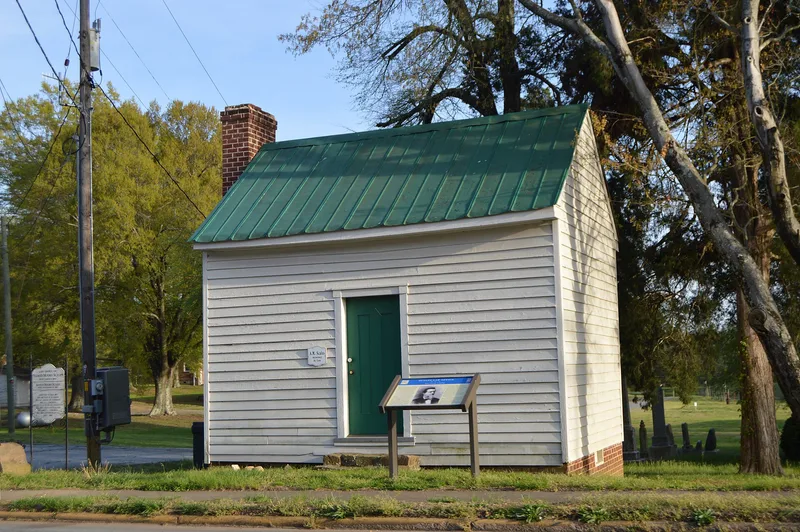
This modest one-room frame building in Madison, North Carolina, served as the law office of Alfred Moore Scales in the 1850s. Scales later became a Confederate brigadier general wounded at Chancellorsville and Gettysburg, a congressman, and governor of North Carolina from 1885 to 1890. He advertised the office in 1856 as nearly opposite Dr. Thomas Coyle's house, and he sold it in 1863. The building has plain weatherboard siding, box cornices with returns, and a single original door on its west side. Shed additions and double doors in the north gable end were probably added when it became a storage building. A 1925 map suggests it was shifted to the rear of its lot, within a few yards of its original site, probably to make way for an alley. Nearly every other property linked to Scales has been lost, so this small office is the last tangible reminder of his early career.
Significance in brief: It is the last known surviving structure associated with Alfred Moore Scales, a lawyer, Confederate brigadier general, congressman and North Carolina governor (1885-1890). Scales practiced law here in his early career and won his first elected offices while based in Madison. The nomination cites it under Criterion B for its association with him.
Machine-generated summary. This summary was generated by a language model from the official nomination document and has not been reviewed line by line by an editor. It may contain errors. Check the source document before relying on any detail. Source: nomination document (PDF) · National Archives catalog entry. NRHP reference 82003503, listed April 29, 1982. Summary generated October 2026 (model claude-sonnet-5-5, prompt v1.0-2026-10-29, confidence medium).
Key facts
| Address | 307 Carter St., Madison |
|---|---|
| County | Rockingham County |
| Listed | April 29, 1982 |
| Reference number | 82003503 |
| Resource type | Building |
| Period of significance | 1800-1899 (specific date 1856) |
| Criteria |
|
| Areas of significance | Politics/Government |
| Level of significance | Local |
| Status (as stated in the nomination) | Described as deteriorated, altered and moved (1920s); the office was later adapted as a storage outbuilding and is listed as unoccupied. |
| Acreage | 0.9 |
| Coordinates | 36.38922, -79.95457 (NPS GIS) |
What listing means for this property
For an income-producing building, listing (individually or as a contributing building in a district) is the gateway to the 20% federal rehabilitation tax credit on qualified rehabilitation costs, often stackable with state credits. Work claiming the credit must follow the Secretary of the Interior's Standards and be approved in advance.
Listing does not restrict a private owner acting without federal money or permits; where federal funding or licensing is involved, Section 106 review applies.
Noted as vacant in the nomination. Nomination documents can be decades old; current status may differ. If you are considering buying an empty listed property, read the due-diligence checklist.
General information, not legal or tax advice. Rules change; confirm with your State Historic Preservation Office or a qualified adviser.
Sources and further reading
- National Park Service, National Register of Historic Places database (snapshot May 2026), reference 82003503.
- Nomination form (PDF, National Archives) — catalog entry
- Wikipedia article (used for cross-checking only; text not reproduced here)
- Wikidata Q23073869
- This listing as JSON
Last updated October 2026. Found an error? See the editorial policy for how to report it.