Church of the Holy Trinity

Why it's listed
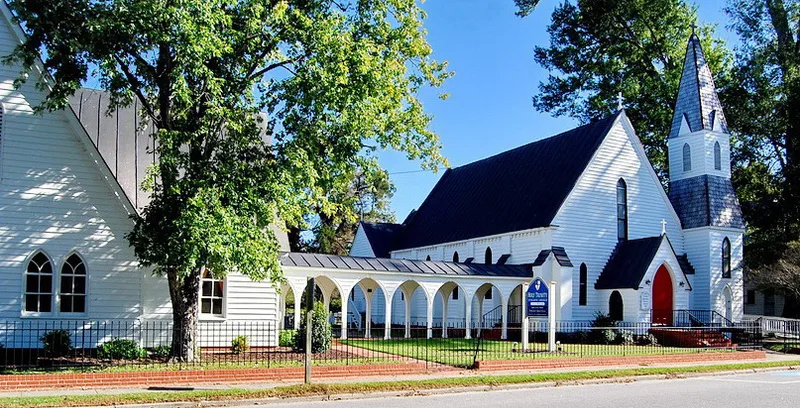
Holy Trinity is a small frame Episcopal church and cemetery in the courthouse and river town of Hertford, North Carolina. Built between 1848 and 1851 under missionary William E. Snowden and senior warden Benjamin S. Skinner, it was consecrated in 1851 by Bishop Levi Silliman Ives, who called it the best wooden building in the diocese. It has a gable-front form, lancet windows, buttresses, a standing-seam tin roof, and a bell tower and front porch added in 1894. Inside are a post-and-beam gallery, a wine-glass pulpit, a tracker organ by George Jardine from about 1854, and stained glass by Owen Doremus and J. & R. Lamb Studios. A parish house and arcade were added in the 1960s. The cemetery holds many antebellum planters and Confederate officers. The church is considered the earliest frame example in the state of the Early English parish church model and an important local example of the Gothic Revival.
Significance in brief: The nomination argues it is the earliest frame example in North Carolina of the Early English parish church promoted by the Ecclesiological movement. It reflects the Episcopal Church's adoption of the Gothic Revival style before the Civil War. It also retains notable original and early furnishings, including a gallery, pulpit, and 1850s organ and stained glass.
Machine-generated summary. This summary was generated by a language model from the official nomination document and has not been reviewed line by line by an editor. It may contain errors. Check the source document before relying on any detail. Source: nomination document (PDF) · National Archives catalog entry. NRHP reference 98000688, listed June 11, 1998. Summary generated October 2026 (model claude-sonnet-5-5, prompt v1.0-2026-10-29, confidence high).
Key facts
| Address | 207 S. Church St., Hertford |
|---|---|
| County | Perquimans County |
| Listed | June 11, 1998 |
| Reference number | 98000688 |
| Resource type | Building |
| Period of significance | 1848-1948 |
| Architect / builder | Unknown; T. W. Watson (1894 steeple) |
| Architectural style | Gothic Revival |
| Criteria |
|
| Areas of significance | Architecture, Religion |
| Level of significance | Local |
| Status (as stated in the nomination) | The organ continues to be used regularly; the church and cemetery retain religious and funerary use. |
| Acreage | 1.9 |
| Within district | Hertford Historic District |
| Coordinates | 36.18733, -76.46642 (NPS GIS) |
What listing means for this property
Religious properties are listed for their architectural or historical significance, not their religious use. Listing is honorary and does not restrict the congregation's use of the building. The federal rehabilitation credit is generally unavailable unless part of the building is income-producing; some state programmes and preservation grants do cover religious buildings. Federal funding or permits trigger Section 106 review.
General information, not legal or tax advice. Rules change; confirm with your State Historic Preservation Office or a qualified adviser.
Sources and further reading
- National Park Service, National Register of Historic Places database (snapshot May 2026), reference 98000688.
- Nomination form (PDF, National Archives) — catalog entry
- Wikipedia article (used for cross-checking only; text not reproduced here)
- Wikidata Q5117943
- This listing as JSON
Last updated October 2026. Found an error? See the editorial policy for how to report it.