Mount Lebanon Chapel and Cemetery
Also known as: Lebanon Chapel

Why it's listed
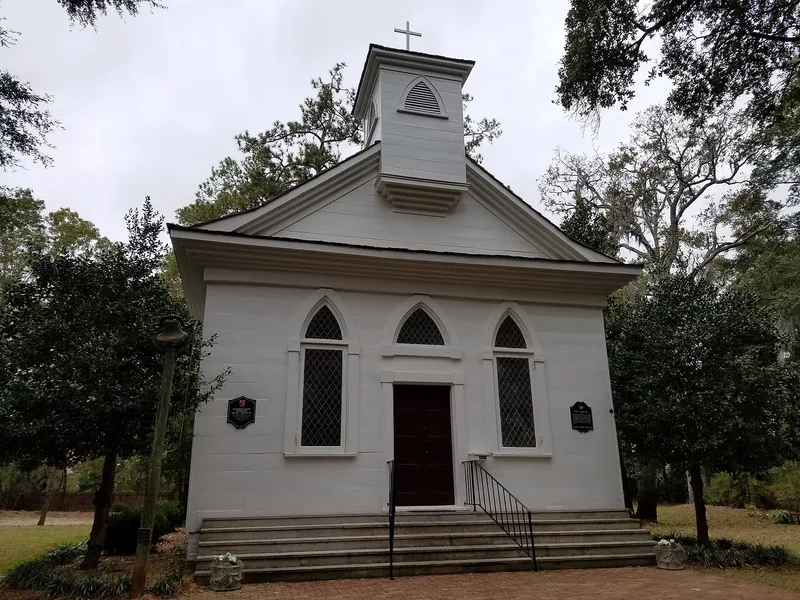
Mt. Lebanon Chapel is a small Episcopal chapel in a clearing within Airlie Gardens, near Wrightsville Beach. Dr. Thomas H. Wright built it in 1835 on part of his family's Mt. Lebanon property, and lay readers from St. James Church in Wilmington held summer services there. The weatherboarded frame building rests on brick piers and has pointed-arch openings with diamond-paned windows, a five-step cornice and a corbelled belfry. A walled cemetery lies about a hundred feet south, holding ninety-one burials from 1815 to 1964, including members of several Wilmington families. The chapel is considered the oldest known surviving religious structure in New Hanover County and a sturdy example of vernacular Greco-Gothic design. Legal title passed to the vestry of St. James Parish in 1875. After vandals damaged the building in 1971 and 1972, it was restored and rededicated in 1974. It is now used for special services and weddings.
Significance in brief: The nomination argues the chapel is a simple, sturdy example of Greco-Gothic vernacular architecture and the oldest known surviving religious structure in New Hanover County. It is also tied to the development of the Greenville, Masonboro and Wrightsville Sound areas. The adjoining cemetery, with burials from 1815 to 1964, represents nineteenth and twentieth century regional cemeteries.
Machine-generated summary. This summary was generated by a language model from the official nomination document and has not been reviewed line by line by an editor. It may contain errors. Check the source document before relying on any detail. Source: nomination document (PDF) · National Archives catalog entry. NRHP reference 86002879, listed October 16, 1986. Summary generated October 2026 (model claude-sonnet-5-5, prompt v1.0-2026-10-29, confidence high).
Key facts
| Address | SR 1411, Wrightsville Beach |
|---|---|
| County | New Hanover County |
| Listed | October 16, 1986 |
| Reference number | 86002879 |
| Resource type | Building |
| Period of significance | 1800-1899 |
| Architect / builder | Unknown (built by Dr. Thomas H. Wright, who erected the chapel) |
| Architectural style | Greco-Gothic, vernacular (also described as Greek Revival) |
| Criteria |
|
| Areas of significance | Architecture |
| Level of significance | Local |
| Status (as stated in the nomination) | Restored and rededicated in April 1974 after vandalism; currently used for special services and weddings. |
| Acreage | 6.5 |
| Coordinates | 34.21415, -77.82610 (NPS GIS) |
What listing means for this property
Religious properties are listed for their architectural or historical significance, not their religious use. Listing is honorary and does not restrict the congregation's use of the building. The federal rehabilitation credit is generally unavailable unless part of the building is income-producing; some state programmes and preservation grants do cover religious buildings. Federal funding or permits trigger Section 106 review.
General information, not legal or tax advice. Rules change; confirm with your State Historic Preservation Office or a qualified adviser.
Sources and further reading
- National Park Service, National Register of Historic Places database (snapshot May 2026), reference 86002879.
- Nomination form (PDF, National Archives) — catalog entry
- Wikipedia article (used for cross-checking only; text not reproduced here)
- Wikidata Q6921796
- This listing as JSON
Last updated October 2026. Found an error? See the editorial policy for how to report it.