Peebles House
Also known as: Harmony Hall
Peebles House is a building in Kinston, Lenoir County, North Carolina, listed on the National Register of Historic Places on August 26, 1971 (reference number 71000603). The National Park Service records its significance in Politics/Government and Architecture at the state level.
Facts from the NPS National Register database (); nomination summary October 2026. Last updated . Sources for each fact.

Approximate location: the National Park Service places this pin arbitrarily within the property, not at a surveyed point (stated accuracy ±12 m).
Why it's listed
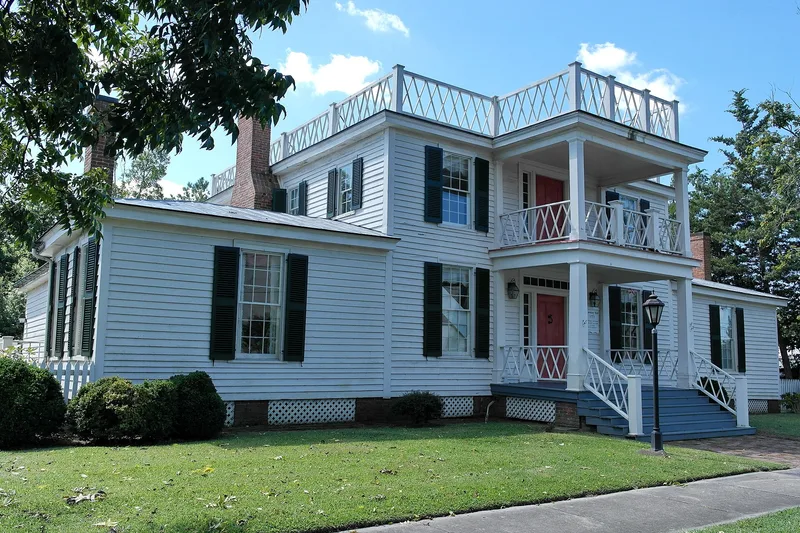
Harmony Hall, also known as the Peebles House, is a two-story frame house on East King Street in Kinston. Its oldest section may have been built by Jesse and Elizabeth Cobb between 1772 and 1776, which makes it thought to be the town's oldest house. During the Revolution, Governor Richard Caswell moved major state offices to Kinston, and secretary of state James Glasgow lived in the house, keeping official records there until the British threatened the town in 1781. The State Board of War also met in the house. Caswell later owned it and gave it to his son in 1782. Extensive remodeling in the 1790s was followed by wings added about 1830 and Greek Revival trim by mid-century. A low pyramidal roof replaced an earlier gable roof. John Henry Peebles, a member of Kinston's first city council, acquired the house in 1845. Since 1937 the Kinston Woman's Club has maintained it as a meeting place for civic and private groups.
Significance in brief: The form calls it thought to be the oldest house in Kinston and notes its link to Richard Caswell, first governor of North Carolina. During the Revolution it housed James Glasgow, the secretary of state, and state records, and it hosted meetings of the State Board of War. It is also an eighteenth-century house greatly modified by later owners in Georgian, Federal and Greek Revival styles.
Machine-generated summary. This summary was generated by a language model from the official nomination document and has not been reviewed line by line by an editor. It may contain errors. Check the source document before relying on any detail. Source: nomination document (PDF) · National Archives catalog entry. NRHP reference 71000603, listed August 26, 1971. Summary generated October 2026 (model claude-sonnet-5-5, prompt v1.0-2026-10-29, confidence medium).
Key facts
| Official database NPS National Register database, ref. 71000603 , checked | |
|---|---|
| Address | 109 E. King St., Kinston |
| County | Lenoir County |
| Listed | August 26, 1971 |
| Reference number | 71000603 |
| Resource type | Building |
| Areas of significance | Politics/Government, Architecture |
| Level of significance | State |
| National Historic Landmark | No |
| Acreage | 0.5 |
| Official document, machine-extracted Nomination form (National Archives) , checked | |
| Architect / builder | Possibly built by Jesse and Elizabeth Cobb |
| Architectural style | Georgian, Federal and Greek Revival elements |
| Status (as stated in the nomination) | Listed in good condition and occupied; used as a clubhouse and meeting place by the Kinston Woman's Club since 1937. |
| Official dataset NPS cultural-resource GIS (NRHP locations) | |
| Coordinates | 35.25933, -77.58275 |
What listing means for this property
National Register listing is honorary for a privately owned home: it does not by itself restrict what an owner may do with their own money, and it does not require public access. Restrictions come from local landmark or historic-district ordinances, which are separate (how they differ).
Owner-occupied houses are not eligible for the 20% federal rehabilitation tax credit, which applies to income-producing buildings, but many states offer credits for homeowners. Listing also opens the door to preservation easements and to buying a plaque. Start with what listing means for homeowners, renovating a listed house and selling one.
General information, not legal or tax advice. Rules change; confirm with your State Historic Preservation Office or a qualified adviser.
Questions about Peebles House
When was Peebles House added to the National Register of Historic Places?
Peebles House was listed on August 26, 1971. Its National Register reference number is 71000603.
Is Peebles House a National Historic Landmark?
No. The National Park Service database (snapshot of May 2026) lists Peebles House on the National Register but does not record it as a National Historic Landmark.
Where is Peebles House?
109 E. King St., Kinston, Lenoir County, North Carolina; coordinates 35.25933, -77.58275.
Why is Peebles House historically significant?
According to a machine-generated summary of its nomination form: The form calls it thought to be the oldest house in Kinston and notes its link to Richard Caswell, first governor of North Carolina. During the Revolution it housed James Glasgow, the secretary of state, and state records, and it hosted meetings of the State Board of War. It is also an eighteenth-century house greatly modified by later owners in Georgian, Federal and Greek Revival styles. Check the nomination document before relying on any detail.
Who designed or built Peebles House?
The nomination form names Possibly built by Jesse and Elizabeth Cobb as architect or builder (extracted by machine from the nomination; check the source document).
Where can I read the original nomination for Peebles House?
The nomination form is a public record held by the National Archives: nomination document (PDF).
Sources and further reading
- National Park Service, National Register of Historic Places database (snapshot May 2026), reference 71000603.
- Nomination form (PDF, National Archives) — catalog entry
- Wikipedia article (used for cross-checking only; text not reproduced here)
- Wikidata Q19867720
- This listing as JSON
Last updated November 2026. Found an error? See the editorial policy for how to report it.