Kennedy Memorial Home Historic District
Also known as: Cedar Dell

Why it's listed
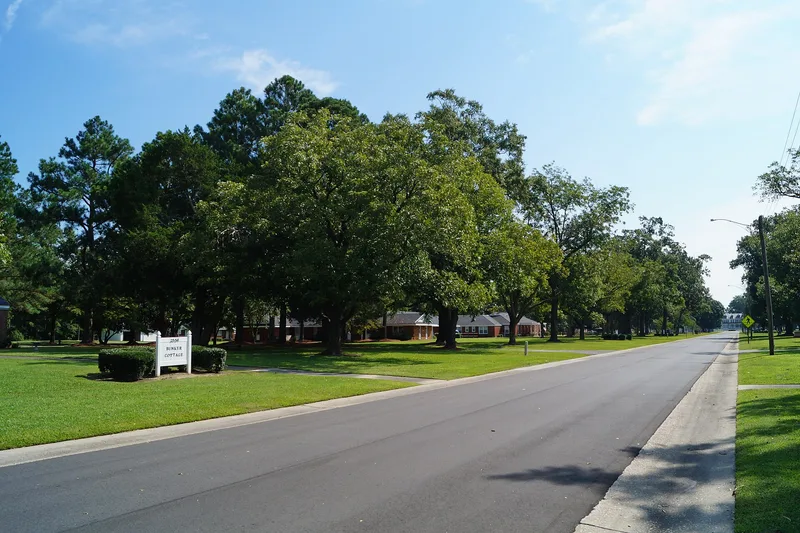
Set along a broad avenue off Kennedy Home Road, the district combines a plantation landscape with a working orphanage. Cedar Dell, a two-and-one-half-story brick side-hall house begun in 1832, was enlarged in the 1880s with Eastlake veranda and dormers, and its brick kitchen and early outbuildings survive. In 1912 Captain William Kennedy and his wife deeded the property to the Thomasville Baptist orphanage, and the first cottages opened in 1914. Brick Craftsman, Colonial Revival and Ranch-style cottages, a church and farm buildings followed through the 1950s, when enrollment peaked near 160 children. The farm supplied food, feed and fertilizer, and it produced revenue for the institution until agricultural operations ended in 1993. Fields and woodland have changed little since 1940. The district is significant for its social history and its agriculture, reflecting how orphanages cared for children and sustained themselves in mid-twentieth-century North Carolina.
Significance in brief: The nomination argues the district is significant for its long operation as a Baptist orphanage and as a working farm that fed the children and produced income for the institution. It also points to the Federal-period Cedar Dell house, with its Eastlake additions, and to the surviving fields and woodland that show continuity with the farm's appearance in 1940.
Machine-generated summary. This summary was generated by a language model from the official nomination document and has not been reviewed line by line by an editor. It may contain errors. Check the source document before relying on any detail. Source: nomination document (PDF) · National Archives catalog entry. NRHP reference 09000684, listed September 3, 2009. Summary generated October 2026 (model claude-haiku-5-5, prompt v1.1-2026-10-29, confidence high).
Key facts
| Address | 2557 Ceder Dell La., Kinston |
|---|---|
| County | Lenoir County |
| Listed | September 3, 2009 |
| Reference number | 09000684 |
| Resource type | District |
| Period of significance | 1914-1959 |
| Architect / builder | Adams, Jack, architect |
| Architectural style | Federal; Stick/Eastlake; Bungalow/Craftsman |
| Criteria |
|
| Areas of significance | Social History, Agriculture |
| Level of significance | Local |
| Status (as stated in the nomination) | The orphanage remains in operation; the nomination notes that buildings constructed after 1959 are noncontributing. |
| Acreage | 1240 |
| Coordinates | 35.24310, -77.68168 (NPS GIS) |
What listing means for this property
This is a historic district. Buildings within its boundary are either contributing (they add to the district's significance) or non-contributing. Owners of contributing income-producing buildings can claim the 20% federal rehabilitation tax credit; homeowners should look at state credits. National Register districts impose no design review by themselves; a local historic district ordinance, if one exists, does (the difference explained).
General information, not legal or tax advice. Rules change; confirm with your State Historic Preservation Office or a qualified adviser.
Sources and further reading
- National Park Service, National Register of Historic Places database (snapshot May 2026), reference 09000684.
- Nomination form (PDF, National Archives) — catalog entry
- Wikipedia article (used for cross-checking only; text not reproduced here)
- Wikidata Q19462704
- This listing as JSON
Last updated October 2026. Found an error? See the editorial policy for how to report it.