Clayton Historic District
Clayton Historic District is a historic district in Clayton, Johnston County, North Carolina, listed on the National Register of Historic Places on June 7, 2010 (reference number 10000314). The National Park Service records its significance in Architecture, Black and Commerce at the local level.
Facts from the NPS National Register database (); nomination summary October 2026. Last updated . Sources for each fact.

The pin is a point inside the NPS boundary polygon, not a surveyed location.
Why it's listed
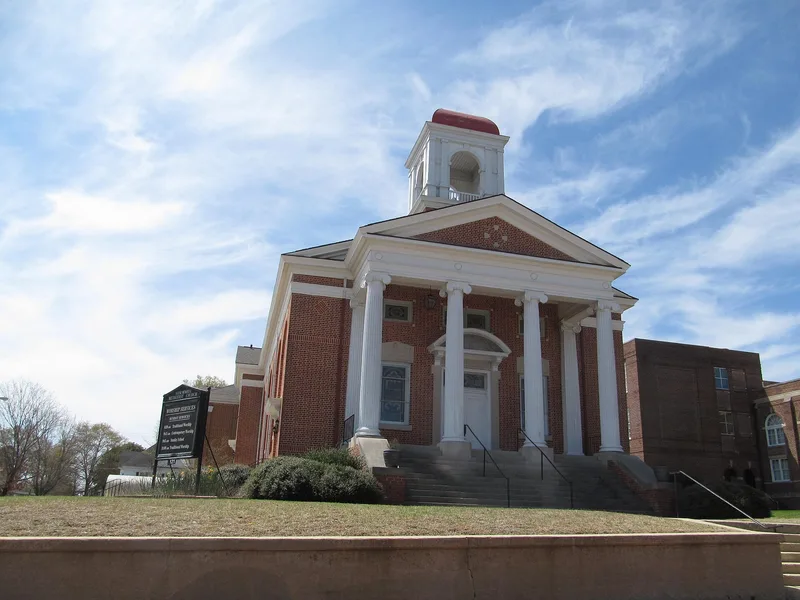
Clayton is a town of frame, brick and masonry buildings grouped around a railroad line in Johnston County, North Carolina. The historic district covers the commercial core along Main and Front streets and the residential streets nearby, with examples from the late nineteenth through mid-twentieth century. Commercial buildings include the 1920 Neoclassical Clayton Banking Company building at 200 East Main Street and the B. M. Robertson Mule Company stable on South Lombard Street. Residences include Queen Anne houses such as the Hinton House on First Street and Colonial Revival houses, along with bungalows and mill houses tied to the Clayton Cotton Mill, which was organized in 1900. The district is important for its role as a regional cotton market and for an African American neighborhood on the north side of the tracks that grew after 1900, with concrete block stores built in the 1940s. The district also holds Horne Memorial United Methodist Church, built 1912 to 1916.
Significance in brief: The nomination argues the district is significant under Criterion A for commerce and for the Black ethnic heritage of an African American neighborhood that developed after segregation was codified, and under Criterion C for its collection of popular and vernacular architectural styles. The period of significance runs from ca. 1850 to 1959, covering the town's growth as a regional trading and cotton market center.
Machine-generated summary. This summary was generated by a language model from the official nomination document and has not been reviewed line by line by an editor. It may contain errors. Check the source document before relying on any detail. Source: nomination document (PDF) · National Archives catalog entry. NRHP reference 10000314, listed June 7, 2010. Summary generated October 2026 (model claude-haiku-5-5, prompt v1.1-2026-10-29, confidence medium).
Key facts
| Official database NPS National Register database, ref. 10000314 , checked | |
|---|---|
| Address | Bounded by Mulberry St, W Barnes St, Mill St, S Lombard St, Blanch St, Clayton |
| County | Johnston County |
| Listed | June 7, 2010 |
| Reference number | 10000314 |
| Resource type | District |
| Areas of significance | Architecture, Black, Commerce |
| Level of significance | Local |
| National Historic Landmark | No |
| Acreage | 110 |
| Official document, machine-extracted Nomination form (National Archives) , checked | |
| Period of significance | ca. 1850-1959 |
| Architect / builder | Ellis, George. W., contractor; Young, John, carpenter; Frank Jones and Sons, carpenters; Price, J. Henry & Son (Maurice), contractor |
| Architectural style | Italianate, Queen Anne, Colonial Revival, Tudor Revival, Classical Revival, Bungalow/Craftsman, Ranch, I-house |
| Criteria |
|
| Official dataset NPS cultural-resource GIS (NRHP locations) | |
| Coordinates | 35.65527, -78.45818 |
What listing means for this property
This is a historic district. Buildings within its boundary are either contributing (they add to the district's significance) or non-contributing. Owners of contributing income-producing buildings can claim the 20% federal rehabilitation tax credit; homeowners should look at state credits. National Register districts impose no design review by themselves; a local historic district ordinance, if one exists, does (the difference explained).
General information, not legal or tax advice. Rules change; confirm with your State Historic Preservation Office or a qualified adviser.
Questions about Clayton Historic District
When was Clayton Historic District added to the National Register of Historic Places?
Clayton Historic District was listed on June 7, 2010. Its National Register reference number is 10000314.
Is Clayton Historic District a National Historic Landmark?
No. The National Park Service database (snapshot of May 2026) lists Clayton Historic District on the National Register but does not record it as a National Historic Landmark.
Where is Clayton Historic District?
Bounded by Mulberry St, W Barnes St, Mill St, S Lombard St, Blanch St, Clayton, Johnston County, North Carolina; coordinates 35.65527, -78.45818.
Why is Clayton Historic District historically significant?
According to a machine-generated summary of its nomination form: The nomination argues the district is significant under Criterion A for commerce and for the Black ethnic heritage of an African American neighborhood that developed after segregation was codified, and under Criterion C for its collection of popular and vernacular architectural styles. The period of significance runs from ca. 1850 to 1959, covering the town's growth as a regional trading and cotton market center. Check the nomination document before relying on any detail.
Who designed or built Clayton Historic District?
The nomination form names Ellis, George. W., contractor; Young, John, carpenter; Frank Jones and Sons, carpenters; Price, J. Henry & Son (Maurice), contractor as architect or builder (extracted by machine from the nomination; check the source document).
Where can I read the original nomination for Clayton Historic District?
The nomination form is a public record held by the National Archives: nomination document (PDF).
Sources and further reading
- National Park Service, National Register of Historic Places database (snapshot May 2026), reference 10000314.
- Nomination form (PDF, National Archives) — catalog entry
- Wikipedia article (used for cross-checking only; text not reproduced here)
- Wikidata Q19461032
- This listing as JSON
Last updated November 2026. Found an error? See the editorial policy for how to report it.