McKay, John A., House and Manufacturing Company

Why it's listed
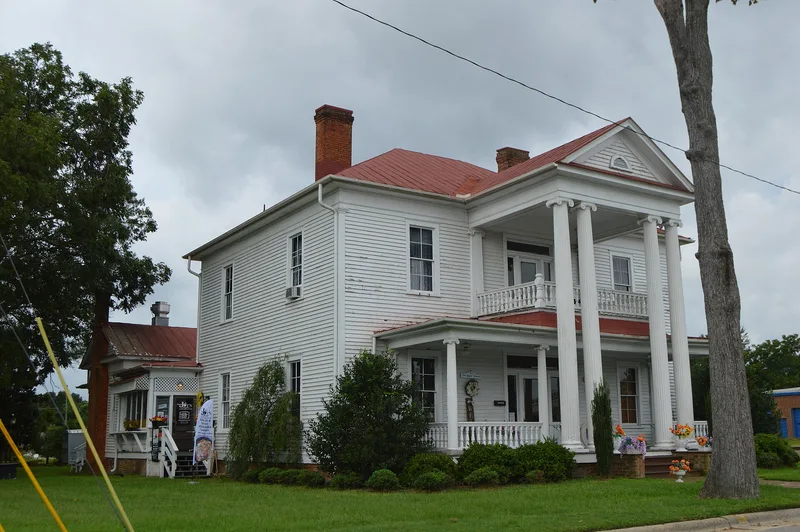
Along the railroad tracks in Dunn, a 1910 house and a cluster of frame industrial buildings record the career of John A. McKay, a carpenter turned hardware merchant, inventor and foundry owner. McKay began in a rented cotton gin in 1889, built a foundry about 1893, and expanded across Pearsall Street in 1910 and 1911 with a larger foundry, blacksmith and machine shops, a steel house and a brick pattern room. His company made turpentine equipment, then horse-drawn and later tractor-powered farm machinery, including stalk cutters, planters and fertilizer spreaders. Much original equipment survives, including a long drive shaft, a core oven and wooden patterns. McKay drew the plans for his house after his grandfather's ca. 1840 Greek Revival plantation house, adding a two-story portico, Ionic columns and Colonial Revival mantels. Cast iron steps and a fence from his foundry remain. The property was listed as an unusually intact industrial site and a well-preserved local house.
Significance in brief: The nomination argues the complex is one of the most intact early 20th century industrial sites in North Carolina and one of very few intact foundries in the state. It is tied to John A. McKay, an inventor and entrepreneur who made farm equipment, and to the industrialization of rural North Carolina. The house shows Greek Revival massing with Colonial Revival detailing, and the site may yield further information on foundry and machine work.
Machine-generated summary. This summary was generated by a language model from the official nomination document and has not been reviewed line by line by an editor. It may contain errors. Check the source document before relying on any detail. Source: nomination document (PDF) · National Archives catalog entry. NRHP reference 86000739, listed April 10, 1986. Summary generated October 2026 (model claude-sonnet-5-5, prompt v1.0-2026-10-29, confidence high).
Key facts
| Address | 100 E. Divine St., Dunn |
|---|---|
| County | Harnett County |
| Listed | April 10, 1986 |
| Reference number | 86000739 |
| Resource type | Building |
| Period of significance | 1800-1899, 1900- (specific dates 1895, ca. 1910 for the manufacturing company; 1910 for the house) |
| Architect / builder | Unknown (the house plans were drawn by John A. McKay) |
| Architectural style | Greek Revival massing with Colonial Revival and Neo-Classical details (house); frame industrial buildings with board and batten siding |
| Criteria |
|
| Areas of significance | Industry, Commerce, Agriculture, Engineering, Architecture, Invention |
| Level of significance | State |
| Status (as stated in the nomination) | The manufacturing company is occupied, with an antique business in the machine shop and ongoing stabilization of the buildings. The house is listed as unoccupied and vacant. Condition is rated good to fair and unaltered. |
| Acreage | 3 |
| Coordinates | 35.30568, -78.61242 (NPS GIS) |
What listing means for this property
National Register listing is honorary for a privately owned home: it does not by itself restrict what an owner may do with their own money, and it does not require public access. Restrictions come from local landmark or historic-district ordinances, which are separate (how they differ).
Owner-occupied houses are not eligible for the 20% federal rehabilitation tax credit, which applies to income-producing buildings, but many states offer credits for homeowners. Listing also opens the door to preservation easements and to buying a plaque. Start with what listing means for homeowners, renovating a listed house and selling one.
Noted as vacant in the nomination. Nomination documents can be decades old; current status may differ. If you are considering buying an empty listed property, read the due-diligence checklist.
General information, not legal or tax advice. Rules change; confirm with your State Historic Preservation Office or a qualified adviser.
Sources and further reading
- National Park Service, National Register of Historic Places database (snapshot May 2026), reference 86000739.
- Nomination form (PDF, National Archives) — catalog entry
- Wikipedia article (used for cross-checking only; text not reproduced here)
- Wikidata Q19987051
- This listing as JSON
Last updated October 2026. Found an error? See the editorial policy for how to report it.