Lee, Gen. William C., House

Why it's listed
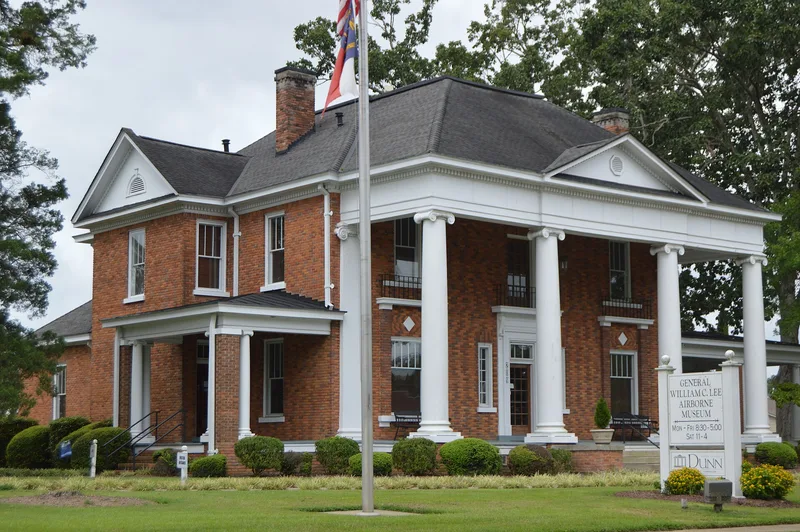
Set on a half-acre corner lot about four blocks from downtown Dunn, this roughly 4,500-square-foot brick house was built around 1915 in the Neo-Classical Revival style. It has a two-story main block, one-story rear wings, a full-facade porch with Tuscan columns, dentil cornices, pedimented gables and a central hall with a staircase. The house was built for Jefferson Davis Barnes, who founded Dunn Oil Mills in 1902 and co-founded the Barnes & Halliday hardware company. In 1935 it became the home of William C. Lee, a Dunn native who pioneered American paratroop and glider forces and is remembered as the father of America's airborne army. Lee wrote airborne doctrine and devised tactical plans for the D-Day invasion, though a heart ailment forced him home before it began. He died in 1948. The house is recognized for its association with both men and as a local example of brick Neo-Classical Revival design. It now holds apartments and Chamber of Commerce offices, with a museum planned.
Significance in brief: The house is tied to Major General William C. Lee, a Dunn native known as the father of America's airborne army, who lived there for thirteen years. It is also associated with J. D. Barnes, a prominent local businessman. It is a locally significant brick example of Neo-Classical Revival residential architecture in small North Carolina towns.
Machine-generated summary. This summary was generated by a language model from the official nomination document and has not been reviewed line by line by an editor. It may contain errors. Check the source document before relying on any detail. Source: nomination document (PDF) · National Archives catalog entry. NRHP reference 83003968, listed November 25, 1983. Summary generated October 2026 (model claude-sonnet-5-5, prompt v1.0-2026-10-29, confidence high).
Key facts
| Address | 209 W. Divine St., Dunn |
|---|---|
| County | Harnett County |
| Listed | November 25, 1983 |
| Reference number | 83003968 |
| Resource type | Building |
| Period of significance | 1900- (specific date ca. 1915) |
| Architectural style | Neo-Classical Revival |
| Criteria |
|
| Areas of significance | Military, Architecture |
| Level of significance | State |
| Status (as stated in the nomination) | Occupied: contains two private apartments and offices of the Dunn Area Chamber of Commerce; plans call for restoration and a museum honoring General Lee. |
| Acreage | 0.9 |
| Coordinates | 35.30751, -78.61379 (NPS GIS) |
What listing means for this property
National Register listing is honorary for a privately owned home: it does not by itself restrict what an owner may do with their own money, and it does not require public access. Restrictions come from local landmark or historic-district ordinances, which are separate (how they differ).
Owner-occupied houses are not eligible for the 20% federal rehabilitation tax credit, which applies to income-producing buildings, but many states offer credits for homeowners. Listing also opens the door to preservation easements and to buying a plaque. Start with what listing means for homeowners, renovating a listed house and selling one.
General information, not legal or tax advice. Rules change; confirm with your State Historic Preservation Office or a qualified adviser.
Sources and further reading
- National Park Service, National Register of Historic Places database (snapshot May 2026), reference 83003968.
- Nomination form (PDF, National Archives) — catalog entry
- Wikipedia article (used for cross-checking only; text not reproduced here)
- Wikidata Q19986760
- This listing as JSON
Last updated October 2026. Found an error? See the editorial policy for how to report it.