Sterling Cotton Mill
Also known as: Franklinton Cotton Mill

Why it's listed
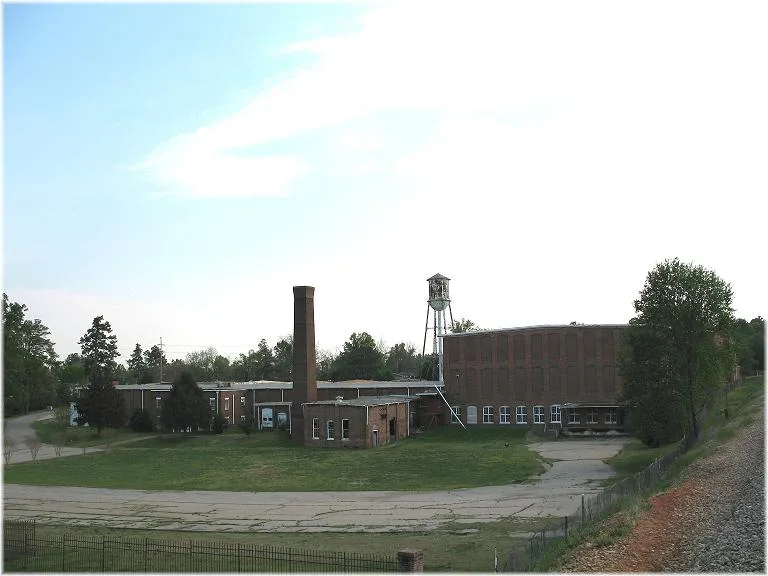
Sterling Cotton Mill is a brick textile mill beside the Seaboard Railroad tracks in Franklinton, the largest building in the railroad town. Samuel C. Vann established the mill in 1895 with about thirty subscribers, most of them family members, and the original one-story section was built from clay dug on the site, which later became the water reservoir for the steam engine. A two-story addition in 1914 tripled the production area, and the mill employed around 400 people by the early 1940s, during World War II. The Vann family ran the mill until 1972, when it was sold to Union Underwear Company, and it closed in 1991. Its brick walls, segmental-arched windows, chamfered pine posts and shallow gable roofs are regarded as a representative example of Industrial Italianate textile mill design. The mill is also significant for its role as a major local employer and for the many Franklin County residents who started their working lives there.
Significance in brief: The nomination argues the mill is the only one of two nineteenth-century textile mills in Franklin County to survive, and that it reflects the limited effect of the industrial revolution on this agricultural county. It is also presented as a typical, relatively well-preserved example of the Industrial Italianate utilitarian mill construction common in North Carolina, and as a major employer and family-run business for Franklinton.
Machine-generated summary. This summary was generated by a language model from the official nomination document and has not been reviewed line by line by an editor. It may contain errors. Check the source document before relying on any detail. Source: nomination document (PDF) · National Archives catalog entry. NRHP reference 96000568, listed May 16, 1996. Summary generated October 2026 (model claude-haiku-5-5, prompt v1.1-2026-10-29, confidence high).
Key facts
| Address | SE jct. of Seabord RR tracks and E. Green St., Franklinton |
|---|---|
| County | Franklin County |
| Listed | May 16, 1996 |
| Reference number | 96000568 |
| Resource type | Building |
| Period of significance | 1895-1946 |
| Architectural style | Industrial Italianate |
| Criteria |
|
| Areas of significance | Architecture, Industry |
| Level of significance | Local |
| Status (as stated in the nomination) | Closed in 1991; the 1895 section is used for storage and the rest of the plant is unused. |
| Acreage | 7 |
| Coordinates | 36.10002, -78.45665 (NPS GIS) |
What listing means for this property
For an income-producing building, listing (individually or as a contributing building in a district) is the gateway to the 20% federal rehabilitation tax credit on qualified rehabilitation costs, often stackable with state credits. Work claiming the credit must follow the Secretary of the Interior's Standards and be approved in advance.
Listing does not restrict a private owner acting without federal money or permits; where federal funding or licensing is involved, Section 106 review applies.
Noted as vacant in the nomination. Nomination documents can be decades old; current status may differ. If you are considering buying an empty listed property, read the due-diligence checklist.
General information, not legal or tax advice. Rules change; confirm with your State Historic Preservation Office or a qualified adviser.
Sources and further reading
- National Park Service, National Register of Historic Places database (snapshot May 2026), reference 96000568.
- Nomination form (PDF, National Archives) — catalog entry
- Wikipedia article (used for cross-checking only; text not reproduced here)
- Wikidata Q24436223
- This listing as JSON
Last updated October 2026. Found an error? See the editorial policy for how to report it.