Fuller House
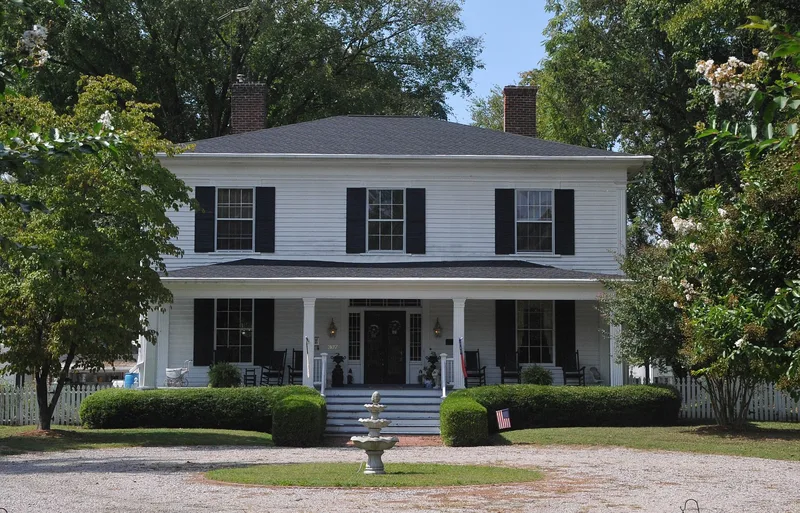
Fuller House is a building in Louisburg, Franklin County, North Carolina, listed on the National Register of Historic Places on November 17, 1978 (reference number 78001954). The National Park Service records its significance in Literature and Architecture at the state level.
Facts from the NPS National Register database (); nomination summary October 2026. Last updated . Sources for each fact.

Approximate location: the National Park Service places this pin arbitrarily within the property, not at a surveyed point (stated accuracy ±12 m).
Why it's listed
Two-story frame house on Main Street in Louisburg, built as a Greek Revival dwelling with a hip roof, a hip-roofed front porch and a center-hall plan with a double stair. Between 1856 and 1857 an older house on the lot was largely torn down and a new one erected on its foundation for Jones Fuller and Anna Long Thomas Fuller, who moved in by late 1857. Its heavy corner pilasters with turned elements and its stair are linked to the regional work of Warren County builder Albert Gamaliel Jones, and the house is regarded as one of the few surviving Greek Revival houses from Louisburg's antebellum period. It was the lifelong home of poet and novelist Edwin Wiley Fuller, born here in 1847 and dying in the house in 1876 at age 28. His mother's diary records the Union occupation of Louisburg in 1865. Fuller's novel Sea Gift drew on his years at the University of North Carolina.
Significance in brief: The house is regarded as one of the relatively few surviving Greek Revival houses from Louisburg's antebellum prosperity, and its details are linked to the regional work of Warren County builder Albert Gamaliel Jones. It was the lifelong home of poet and novelist Edwin Wiley Fuller, who was born there in 1847 and died in the house in 1876. Its significance rests on both its architecture and its connection to Fuller's life and literary career.
Machine-generated summary. This summary was generated by a language model from the official nomination document and has not been reviewed line by line by an editor. It may contain errors. Check the source document before relying on any detail. Source: nomination document (PDF) · National Archives catalog entry. NRHP reference 78001954, listed November 17, 1978. Summary generated October 2026 (model claude-haiku-5-5, prompt v1.1-2026-10-29, confidence high).
Key facts
| Official database NPS National Register database, ref. 78001954 , checked | |
|---|---|
| Address | 307 N. Main St., Louisburg |
| County | Franklin County |
| Listed | November 17, 1978 |
| Reference number | 78001954 |
| Resource type | Building |
| Areas of significance | Literature, Architecture |
| Level of significance | State |
| National Historic Landmark | No |
| Acreage | 1.5 |
| Official document, machine-extracted Nomination form (National Archives) , checked | |
| Period of significance | 1840s-1861 |
| Architectural style | Greek Revival |
| Criteria |
|
| Status (as stated in the nomination) | Under renovation after a period of neglect. |
| Official dataset NPS cultural-resource GIS (NRHP locations) | |
| Coordinates | 36.10376, -78.29917 |
| Computed Computed from NPS GIS district boundaries | |
| Within district | Louisburg Historic District |
What listing means for this property
National Register listing is honorary for a privately owned home: it does not by itself restrict what an owner may do with their own money, and it does not require public access. Restrictions come from local landmark or historic-district ordinances, which are separate (how they differ).
Owner-occupied houses are not eligible for the 20% federal rehabilitation tax credit, which applies to income-producing buildings, but many states offer credits for homeowners. Listing also opens the door to preservation easements and to buying a plaque. Start with what listing means for homeowners, renovating a listed house and selling one.
General information, not legal or tax advice. Rules change; confirm with your State Historic Preservation Office or a qualified adviser.
Questions about Fuller House
When was Fuller House added to the National Register of Historic Places?
Fuller House was listed on November 17, 1978. Its National Register reference number is 78001954.
Is Fuller House a National Historic Landmark?
No. The National Park Service database (snapshot of May 2026) lists Fuller House on the National Register but does not record it as a National Historic Landmark.
Where is Fuller House?
307 N. Main St., Louisburg, Franklin County, North Carolina; coordinates 36.10376, -78.29917.
Why is Fuller House historically significant?
According to a machine-generated summary of its nomination form: The house is regarded as one of the relatively few surviving Greek Revival houses from Louisburg's antebellum prosperity, and its details are linked to the regional work of Warren County builder Albert Gamaliel Jones. It was the lifelong home of poet and novelist Edwin Wiley Fuller, who was born there in 1847 and died in the house in 1876. Its significance rests on both its architecture and its connection to Fuller's life and literary career. Check the nomination document before relying on any detail.
Is Fuller House in a historic district?
Yes. Its location falls within the Louisburg Historic District, itself listed on the National Register. (Computed from National Park Service boundary data; the district nomination's own list of contributing resources may differ.)
Where can I read the original nomination for Fuller House?
The nomination form is a public record held by the National Archives: nomination document (PDF).
Sources and further reading
- National Park Service, National Register of Historic Places database (snapshot May 2026), reference 78001954.
- Nomination form (PDF, National Archives) — catalog entry
- Wikipedia article (used for cross-checking only; text not reproduced here)
- Wikidata Q19461875
- This listing as JSON
Last updated November 2026. Found an error? See the editorial policy for how to report it.