O'Kelly's Chapel

Approximate location: the National Park Service places this pin arbitrarily within the property, not at a surveyed point (stated accuracy ±12 m).
Why it's listed
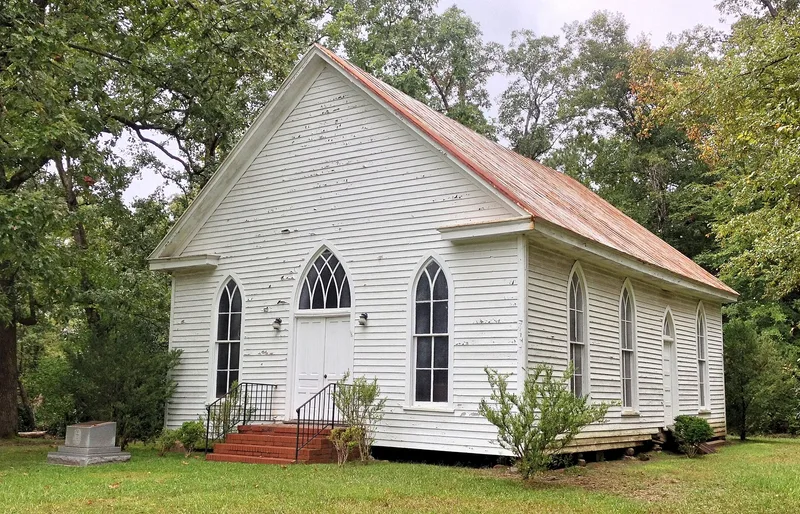
O'Kelly's Chapel is a modest frame country church beside NC 751 near Farrington, close to the Chatham-Durham county line. Built around 1900, it is a one-room building with a gable front, a three-bay facade, and a raised foundation of brick piers. Steeply pitched roofing, lancet windows, and a double-leaf entrance topped by a Gothic transom with intersecting tracery give it a simple Gothic Revival character. Inside, wide wooden planks cover the walls, floor, and ceiling, and hand-carved pews and a carved pump organ complete the rustic look. The chapel is named for Rev. James O'Kelly, a Methodist preacher who broke with the Methodist Episcopal Church in 1794 and founded the Christian Church movement. He settled in northeastern Chatham County in 1797 and preached there until his death in 1826. The present building is the fourth on the site. It has no belfry and has avoided heavy remodeling. Regular congregational use ended by the 1960s.
Significance in brief: It is considered one of the best examples of a small rural Gothic Revival church in Chatham County, and it has not been extensively remodeled. It lacks a belfry, unlike most rural churches in the county. It is also linked to Rev. James O'Kelly and the founding of the Christian Church in the South.
Machine-generated summary. This summary was generated by a language model from the official nomination document and has not been reviewed line by line by an editor. It may contain errors. Check the source document before relying on any detail. Source: nomination document (PDF) · National Archives catalog entry. NRHP reference 85001457, listed July 5, 1985. Summary generated October 2026 (model claude-sonnet-5-5, prompt v1.0-2026-10-29, confidence high).
Key facts
| Address | NC 751, Farrington |
|---|---|
| County | Chatham County |
| Listed | July 5, 1985 |
| Reference number | 85001457 |
| Resource type | Building |
| Period of significance | ca. 1900 |
| Architect / builder | unknown |
| Architectural style | Vernacular Gothic Revival |
| Criteria |
|
| Areas of significance | Architecture, Religion |
| Level of significance | Local |
| Status (as stated in the nomination) | Marked unoccupied and described as no longer in regular use, apart from an occasional spring worship service; members of two sister congregations help with upkeep and preservation. |
| Acreage | 2 |
| Coordinates | 35.86564, -78.94455 (NPS GIS) |
What listing means for this property
Religious properties are listed for their architectural or historical significance, not their religious use. Listing is honorary and does not restrict the congregation's use of the building. The federal rehabilitation credit is generally unavailable unless part of the building is income-producing; some state programmes and preservation grants do cover religious buildings. Federal funding or permits trigger Section 106 review.
General information, not legal or tax advice. Rules change; confirm with your State Historic Preservation Office or a qualified adviser.
Sources and further reading
- National Park Service, National Register of Historic Places database (snapshot May 2026), reference 85001457.
- Nomination form (PDF, National Archives) — catalog entry
- Wikipedia article (used for cross-checking only; text not reproduced here)
- Wikidata Q7071847
- This listing as JSON
Last updated October 2026. Found an error? See the editorial policy for how to report it.