Poteat House
Also known as: Forest Home

Why it's listed
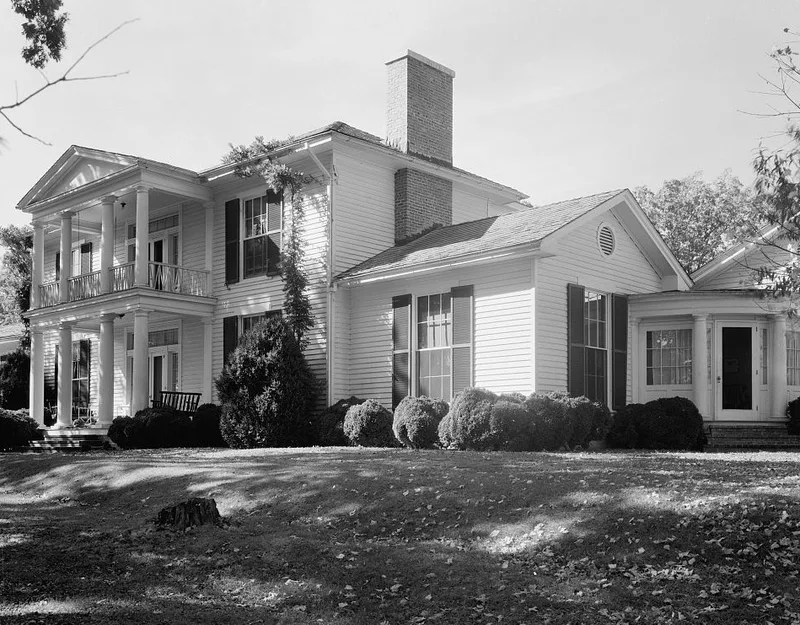
Forest Home, also known as the Poteat House, is a boxy two-story Greek Revival frame house north of Yanceyville in Caswell County. Captain James Poteat, a local militia officer, built it in 1855-56 on a prosperous tobacco and grain plantation. The main block has a double-pedimented Doric portico, flanking one-story wings and richly molded interior woodwork. The family left in 1870 and the house stood empty until 1928, losing its portico and much of its interior trim. Helen Poteat Stallings and her husband, author Laurence Stallings, then restored and enlarged it, copying surviving woodwork so closely that old and new are hard to tell apart. A log slave cabin, tenant houses, tobacco barns and a family cemetery remain on the 619.92-acre estate. The property is also remembered as the birthplace of William Louis Poteat, Wake Forest College president, who resisted fundamentalist attacks on teaching evolution and helped defeat anti-evolution legislation in 1925.
Significance in brief: The nomination argues it is a well-preserved antebellum Greek Revival house that has stayed in one family since it was built. It is also the birthplace and family home of Dr. William Louis Poteat, president of Wake Forest College, who defended academic freedom and the teaching of evolution in the 1920s. The house was restored and expanded in 1928-29.
Machine-generated summary. This summary was generated by a language model from the official nomination document and has not been reviewed line by line by an editor. It may contain errors. Check the source document before relying on any detail. Source: nomination document (PDF) · National Archives catalog entry. NRHP reference 79001688, listed October 24, 1979. Summary generated October 2026 (model claude-sonnet-5-5, prompt v1.0-2026-10-29, confidence high).
Key facts
| Address | N of Yanceyville on NC 62, Yanceyville |
|---|---|
| County | Caswell County |
| Listed | October 24, 1979 |
| Reference number | 79001688 |
| Resource type | Building |
| Period of significance | 1855-1856, 1928-1929 |
| Architect / builder | James Poteat (builder/owner) |
| Architectural style | Greek Revival |
| Criteria |
|
| Areas of significance | Education, Science, Architecture |
| Level of significance | State |
| Status (as stated in the nomination) | Marked occupied and private on the form; the house was restored in 1928 after standing unoccupied from 1870 until then. Part of the land is in pasture and cropland and the rest is a tree farm. |
| Acreage | 619.9 |
| Coordinates | 36.41988, -79.31018 (NPS GIS) |
What listing means for this property
National Register listing is honorary for a privately owned home: it does not by itself restrict what an owner may do with their own money, and it does not require public access. Restrictions come from local landmark or historic-district ordinances, which are separate (how they differ).
Owner-occupied houses are not eligible for the 20% federal rehabilitation tax credit, which applies to income-producing buildings, but many states offer credits for homeowners. Listing also opens the door to preservation easements and to buying a plaque. Start with what listing means for homeowners, renovating a listed house and selling one.
General information, not legal or tax advice. Rules change; confirm with your State Historic Preservation Office or a qualified adviser.
Sources and further reading
- National Park Service, National Register of Historic Places database (snapshot May 2026), reference 79001688.
- Nomination form (PDF, National Archives) — catalog entry
- Wikipedia article (used for cross-checking only; text not reproduced here)
- Wikidata Q18156943
- This listing as JSON
Last updated October 2026. Found an error? See the editorial policy for how to report it.