Church of the Redeemer

Why it's listed
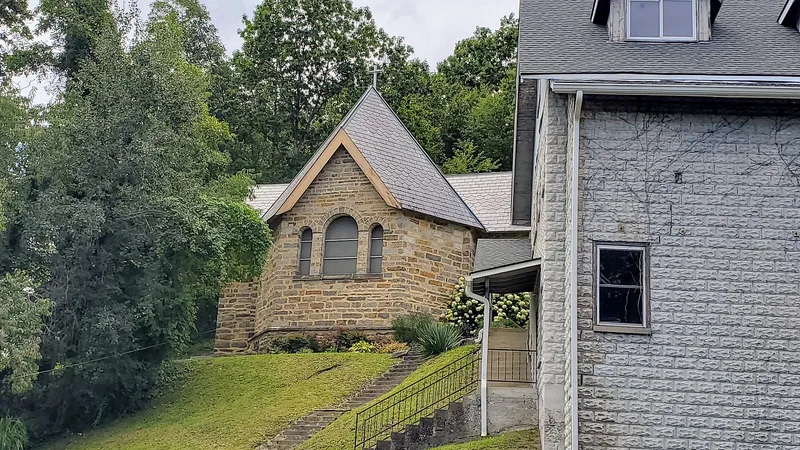
Overlooking the French Broad River just north of Asheville, this small cruciform chapel is built of locally quarried ashlar stone and covered by a steep slate roof with scalloped bands. Dr. Francis Willis, a British physician who emigrated in 1883, had it built between 1886 and 1888 on his estate as a place of worship, mainly for his patients. Local people supplied the labor. It was first called St. Philip's, and in 1898 Willis deeded it to the Episcopal missionary district. It was consecrated as the Church of the Redeemer in 1901. Inside are a hammer beam roof, a Gothic rood screen added around 1920, and a signed Tiffany window in the north transept. A small cemetery above the church, which holds members of the Willis family, is included in the nominated property. The chapel is recognized as a faithful Romanesque design and as an unusual building for the mountain region, reflecting the cosmopolitan newcomers who arrived after the railroad reached Asheville in 1880.
Significance in brief: The chapel is argued to be architecturally significant as a faithful representation of a small Romanesque chapel. It is also an atypical building for the southern mountains, reflecting the arrival of national and international culture in western North Carolina after the railroad came in the 1880s. It began as a private chapel for the patients of a British physician.
Machine-generated summary. This summary was generated by a language model from the official nomination document and has not been reviewed line by line by an editor. It may contain errors. Check the source document before relying on any detail. Source: nomination document (PDF) · National Archives catalog entry. NRHP reference 85002419, listed September 19, 1985. Summary generated October 2026 (model claude-sonnet-5-5, prompt v1.0-2026-10-29, confidence high).
Key facts
| Address | 1202 Riverside Dr., Asheville |
|---|---|
| County | Buncombe County |
| Listed | September 19, 1985 |
| Reference number | 85002419 |
| Resource type | Building |
| Period of significance | 1886-88 |
| Architect / builder | Dr. Francis Willis (presumed) |
| Architectural style | Romanesque (small Romanesque chapel) |
| Criteria |
|
| Areas of significance | Architecture, Religion |
| Level of significance | Local |
| Status (as stated in the nomination) | Occupied and in use as an active Episcopal church; the form rates its condition excellent and unaltered. The parish house is excluded from the nomination. |
| Acreage | 0.7 |
| Coordinates | 35.62453, -82.59229 (NPS GIS) |
What listing means for this property
Religious properties are listed for their architectural or historical significance, not their religious use. Listing is honorary and does not restrict the congregation's use of the building. The federal rehabilitation credit is generally unavailable unless part of the building is income-producing; some state programmes and preservation grants do cover religious buildings. Federal funding or permits trigger Section 106 review.
General information, not legal or tax advice. Rules change; confirm with your State Historic Preservation Office or a qualified adviser.
Sources and further reading
- National Park Service, National Register of Historic Places database (snapshot May 2026), reference 85002419.
- Nomination form (PDF, National Archives) — catalog entry
- Wikipedia article (used for cross-checking only; text not reproduced here)
- Wikidata Q17986484
- This listing as JSON
Last updated October 2026. Found an error? See the editorial policy for how to report it.