Biltmore Village Commercial Buildings
Biltmore Village Commercial Buildings is a building in Asheville, Buncombe County, North Carolina, listed on the National Register of Historic Places on November 15, 1979 (reference number 79001670). The National Park Service records its significance in Commerce, Architecture and Social History at the national level.
Facts from the NPS National Register database (); nomination summary October 2026. Last updated . Sources for each fact.

Approximate location: the National Park Service places this pin arbitrarily within the property, not at a surveyed point (stated accuracy ±12 m).
Why it's listed
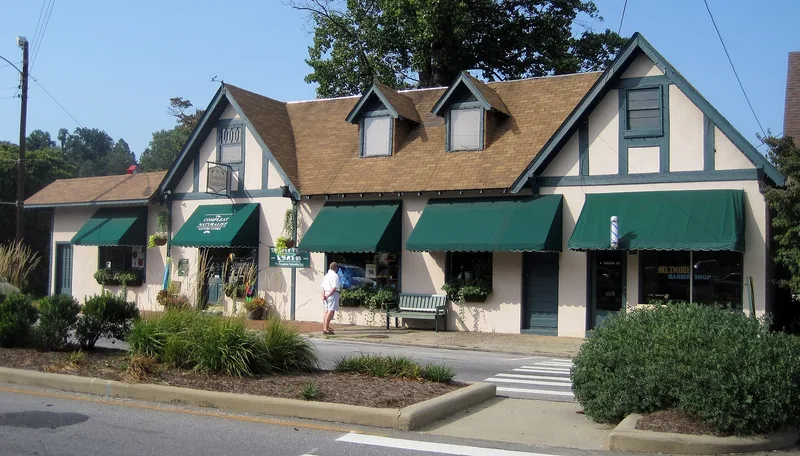
Two adjoining commercial buildings in Biltmore Village, Asheville, dating from about 1900. The building at 2 Biltmore Plaza and 1 1/2 Brook Street is a one-and-one-half story structure with gables at each end and two gable dormers on the center section, with half-timbering in the gable ends. The building at 3 Brook Street is a one-story symmetrical gable-end structure with pebbledash walls, half-timbering and a central gable extension facing the street. Both were designed in the village by architect Richard Sharp Smith, who used the same pebbledash and half-timbering motifs in his residential and commercial work to keep the village visually unified. The buildings were erected for George W. Vanderbilt's planned village, and their surviving design shows how commercial and residential areas were kept in balance. The building at 3 Brook Street once housed the Biltmore Village Post Office and now holds an exterminating company, while the other serves as a barbershop and antique store.
Significance in brief: The nomination argues the buildings are remnants of the design work of architect Richard Sharp Smith in Biltmore Village and examples of how commercial and residential areas of the village were balanced. Smith used the same pebbledash and half-timbering motifs in both residential and commercial buildings, creating visual symmetry across the village. The buildings are also associated with George W. Vanderbilt, for whose manorial village they were built.
Machine-generated summary. This summary was generated by a language model from the official nomination document and has not been reviewed line by line by an editor. It may contain errors. Check the source document before relying on any detail. Source: nomination document (PDF) · National Archives catalog entry. NRHP reference 79001670, listed November 15, 1979. Summary generated October 2026 (model claude-haiku-5-5, prompt v1.1-2026-10-29, confidence medium).
Key facts
| Official database NPS National Register database, ref. 79001670 , checked | |
|---|---|
| Address | Brook St. and Biltmore Plaza, Asheville |
| County | Buncombe County |
| Listed | November 15, 1979 |
| Reference number | 79001670 |
| Resource type | Building |
| Areas of significance | Commerce, Architecture, Social History |
| Level of significance | National |
| National Historic Landmark | No |
| Acreage | 0.9 |
| Official document, machine-extracted Nomination form (National Archives) , checked | |
| Architect / builder | Richard Sharp Smith (architect) |
| Criteria |
|
| Status (as stated in the nomination) | The structure at 3 Brook Street once served as the Biltmore Village Post Office and is now an exterminating company; the other building remains commercial, housing a barbershop and an antique store. |
| Official dataset NPS cultural-resource GIS (NRHP locations) | |
| Coordinates | 35.56765, -82.54273 |
What listing means for this property
National Register listing is honorary: it recognises significance and does not restrict what a private owner may do without federal money or permits. It unlocks the 20% federal rehabilitation tax credit for income-producing buildings, state credits in many states, and Section 106 review when federal agencies are involved. See what listing means in practice.
General information, not legal or tax advice. Rules change; confirm with your State Historic Preservation Office or a qualified adviser.
Questions about Biltmore Village Commercial Buildings
When was Biltmore Village Commercial Buildings added to the National Register of Historic Places?
Biltmore Village Commercial Buildings was listed on November 15, 1979. Its National Register reference number is 79001670.
Is Biltmore Village Commercial Buildings a National Historic Landmark?
No. The National Park Service database (snapshot of May 2026) lists Biltmore Village Commercial Buildings on the National Register but does not record it as a National Historic Landmark.
Where is Biltmore Village Commercial Buildings?
Brook St. and Biltmore Plaza, Asheville, Buncombe County, North Carolina; coordinates 35.56765, -82.54273.
Why is Biltmore Village Commercial Buildings historically significant?
According to a machine-generated summary of its nomination form: The nomination argues the buildings are remnants of the design work of architect Richard Sharp Smith in Biltmore Village and examples of how commercial and residential areas of the village were balanced. Smith used the same pebbledash and half-timbering motifs in both residential and commercial buildings, creating visual symmetry across the village. The buildings are also associated with George W. Vanderbilt, for whose manorial village they were built. Check the nomination document before relying on any detail.
Who designed or built Biltmore Village Commercial Buildings?
The nomination form names Richard Sharp Smith (architect) as architect or builder (extracted by machine from the nomination; check the source document).
Where can I read the original nomination for Biltmore Village Commercial Buildings?
The nomination form is a public record held by the National Archives: nomination document (PDF).
Sources and further reading
- National Park Service, National Register of Historic Places database (snapshot May 2026), reference 79001670.
- Nomination form (PDF, National Archives) — catalog entry
- Wikipedia article (used for cross-checking only; text not reproduced here)
- Wikidata Q17985908
- This listing as JSON
Last updated November 2026. Found an error? See the editorial policy for how to report it.