Oakland Plantation

Why it's listed
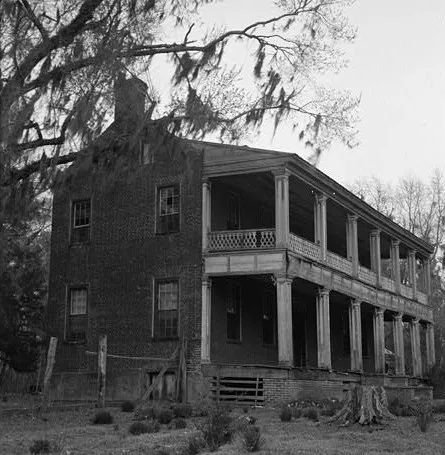
Oakland is a two-story brick plantation house on a high bluff overlooking the Cape Fear River near Carvers in Bladen County. General Thomas Brown, a militia officer who helped suppress the Tory faction during the Revolution, built it probably about 1780 on land passed down from the Bartram family. The house is laid in Flemish bond, six bays wide, with a high brick basement and full-height porches that are twentieth-century replacements. Inside, an unusual plan places a through hall beside a large parlor with the finest late Georgian woodwork, including a dentil cornice and a pilastered overmantel. A long avenue of cedars and old hardwoods leads to a four-acre yard of magnolias and live oaks hung with Spanish moss, and lawns run down to the river. The property remained in the Brown family for generations. It was recognized as a well-preserved post-Revolutionary house and as a vivid example of the Old South plantation setting.
Significance in brief: The nomination presents Oakland as a well-preserved post-Revolutionary plantation house with handsome late Georgian interiors, one of few of its type and period left in the state. Its long tree-lined approach and riverside setting are described as conveying the romanticised ideal of the Old South. It is also tied to Thomas Brown, a Revolutionary-era militia leader against Bladen County Tories.
Machine-generated summary. This summary was generated by a language model from the official nomination document and has not been reviewed line by line by an editor. It may contain errors. Check the source document before relying on any detail. Source: nomination document (PDF) · National Archives catalog entry. NRHP reference 72000924, listed April 25, 1972. Summary generated October 2026 (model claude-sonnet-5-5, prompt v1.0-2026-10-29, confidence medium).
Key facts
| Address | Off SR 1730, Carvers |
|---|---|
| County | Bladen County |
| Listed | April 25, 1972 |
| Reference number | 72000924 |
| Resource type | Building |
| Period of significance | 18th Century |
| Architect / builder | General Thomas Brown (builder) |
| Architectural style | Late Georgian |
| Areas of significance | Architecture |
| Level of significance | State |
| Status (as stated in the nomination) | Condition listed as excellent and altered, on its original site; the form records it as a private residence. |
| Acreage | 64 |
| Coordinates | 34.47169, -78.39306 (NPS GIS) |
What listing means for this property
National Register listing is honorary for a privately owned home: it does not by itself restrict what an owner may do with their own money, and it does not require public access. Restrictions come from local landmark or historic-district ordinances, which are separate (how they differ).
Owner-occupied houses are not eligible for the 20% federal rehabilitation tax credit, which applies to income-producing buildings, but many states offer credits for homeowners. Listing also opens the door to preservation easements and to buying a plaque. Start with what listing means for homeowners, renovating a listed house and selling one.
General information, not legal or tax advice. Rules change; confirm with your State Historic Preservation Office or a qualified adviser.
Sources and further reading
- National Park Service, National Register of Historic Places database (snapshot May 2026), reference 72000924.
- Nomination form (PDF, National Archives) — catalog entry
- Wikipedia article (used for cross-checking only; text not reproduced here)
- Wikidata Q7074039
- This listing as JSON
Last updated October 2026. Found an error? See the editorial policy for how to report it.