Hawfields Presbyterian Church

Why it's listed
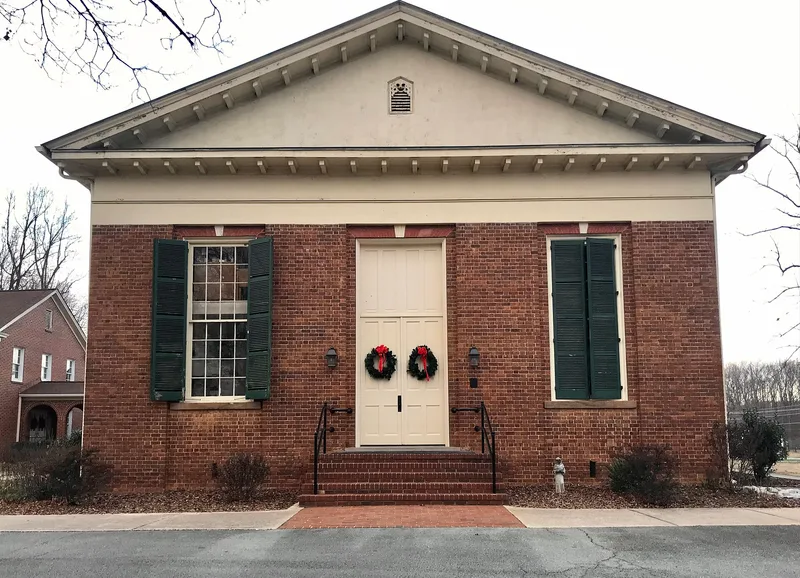
Hawfields Presbyterian Church is a rural congregation complex near Mebane whose core is a brick temple-form church built between 1852 and 1855. Members donated much of the labor and materials, and the handmade bricks are laid in Flemish bond with restrained Greek Revival detail, including a pedimented front, tall sixteen-over-sixteen windows and a interior gallery on fluted metal columns. A two-story classroom addition from the early 1920s, a small frame session house, and the cemetery across the road complete the historic portions. The congregation traces its origins to the mid-eighteenth century, when Scotch-Irish settlers arrived from Pennsylvania, Maryland and Virginia. Ministers such as Henry Patillo and William Paisley shaped its early history, and the Orange Presbytery first met here in 1770. The Scott family, including two governors, were longtime members. Hawfields later served as mother church to seven nearby congregations and remains an active church.
Significance in brief: The congregation dates to the mid-eighteenth century and grew from Scotch-Irish settlement of the Piedmont. The church is tied to early Presbyterian ministers such as Henry Patillo and William Paisley and to the politically prominent Scott family. The 1850s building is a carefully preserved example of vernacular Greek Revival church architecture with Flemish bond brickwork.
Machine-generated summary. This summary was generated by a language model from the official nomination document and has not been reviewed line by line by an editor. It may contain errors. Check the source document before relying on any detail. Source: nomination document (PDF) · National Archives catalog entry. NRHP reference 78001926, listed December 15, 1978. Summary generated October 2026 (model claude-sonnet-5-5, prompt v1.0-2026-10-29, confidence high).
Key facts
| Address | SW of Mebane on NC 119, Mebane |
|---|---|
| County | Alamance County |
| Listed | December 15, 1978 |
| Reference number | 78001926 |
| Resource type | Building |
| Period of significance | 1800-1899 |
| Architectural style | Vernacular Greek Revival |
| Criteria |
|
| Areas of significance | Architecture, Religion |
| Level of significance | State |
| Status (as stated in the nomination) | Listed as occupied, in excellent condition, and in religious use; the congregation continues to worship there and has added modern buildings around the nineteenth-century core. |
| Acreage | 9 |
| Coordinates | 36.05775, -79.30621 (NPS GIS) |
What listing means for this property
Religious properties are listed for their architectural or historical significance, not their religious use. Listing is honorary and does not restrict the congregation's use of the building. The federal rehabilitation credit is generally unavailable unless part of the building is income-producing; some state programmes and preservation grants do cover religious buildings. Federal funding or permits trigger Section 106 review.
General information, not legal or tax advice. Rules change; confirm with your State Historic Preservation Office or a qualified adviser.
Sources and further reading
- National Park Service, National Register of Historic Places database (snapshot May 2026), reference 78001926.
- Nomination form (PDF, National Archives) — catalog entry
- Wikipedia article (used for cross-checking only; text not reproduced here)
- Wikidata Q5684742
- This listing as JSON
Last updated October 2026. Found an error? See the editorial policy for how to report it.