Cross Roads Presbyterian Church and Cemetery and Stainback Store

Why it's listed
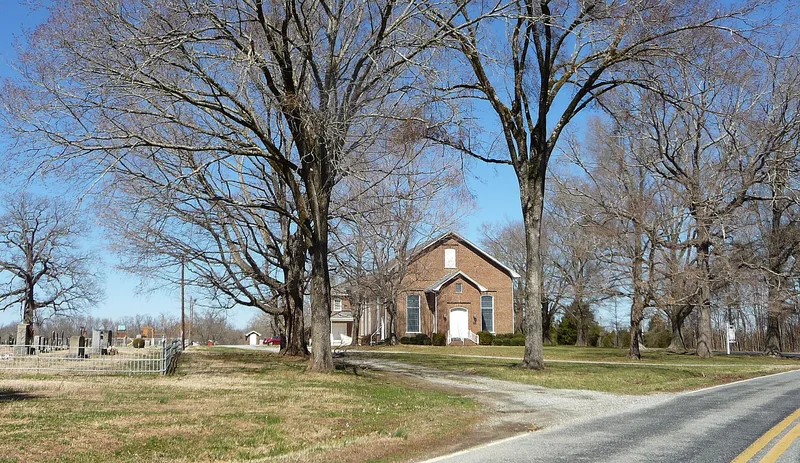
Clustered around a rural intersection about five miles north of Mebane, this group of three resources includes a brick Presbyterian church, its cemetery and a former general store. The one-and-a-half-story church was built in 1876 on a ridge among oak trees and later gained educational wings. The cemetery, dating from about 1792, holds more than 850 tombstones, the oldest dated 1796, and records the families who settled the area. Across the road, the Stainback Store grew from a store established by the Murray brothers in 1841. About 1888 John Wesley Stainback reused lumber from the congregation's old frame church to enlarge it. The site matters for its religious history: in August 1801 the congregation hosted the first Great Revival meeting in North Carolina. It also illustrates the importance of church and store in a farming community, and the plain vernacular building style of the late nineteenth century. The store has been vacant since 1973.
Significance in brief: The complex reflects the settlement and development of a rural crossroads community founded by Scotch-Irish farmers, and the role of church and general store in its life. The congregation hosted the first Great Revival meeting in North Carolina in 1801 under the Rev. William Paisley. The church and store are also presented as examples of rural vernacular architecture of the late nineteenth century.
Machine-generated summary. This summary was generated by a language model from the official nomination document and has not been reviewed line by line by an editor. It may contain errors. Check the source document before relying on any detail. Source: nomination document (PDF) · National Archives catalog entry. NRHP reference 84001912, listed May 22, 1984. Summary generated October 2026 (model claude-sonnet-5-5, prompt v1.0-2026-10-29, confidence high).
Key facts
| Address | N of Mebane at SR 1910 and SR 1912, Mebane |
|---|---|
| County | Alamance County |
| Listed | May 22, 1984 |
| Reference number | 84001912 |
| Resource type | Building |
| Period of significance | 1700-1799, 1800-1899 |
| Architect / builder | Brown Gordon (designed and built the 1876 church, per the narrative); the form's Builder/Architect box says Unknown |
| Architectural style | Vernacular |
| Criteria |
|
| Areas of significance | Architecture, Religion |
| Level of significance | Local |
| Status (as stated in the nomination) | The Stainback Store has been vacant and deteriorating since 1973; the church remains in use as a religious building. |
| Acreage | 7 |
| Coordinates | 36.17020, -79.28626 (NPS GIS) |
What listing means for this property
Religious properties are listed for their architectural or historical significance, not their religious use. Listing is honorary and does not restrict the congregation's use of the building. The federal rehabilitation credit is generally unavailable unless part of the building is income-producing; some state programmes and preservation grants do cover religious buildings. Federal funding or permits trigger Section 106 review.
General information, not legal or tax advice. Rules change; confirm with your State Historic Preservation Office or a qualified adviser.
Sources and further reading
- National Park Service, National Register of Historic Places database (snapshot May 2026), reference 84001912.
- Nomination form (PDF, National Archives) — catalog entry
- Wikipedia article (used for cross-checking only; text not reproduced here)
- Wikidata Q5188410
- This listing as JSON
Last updated October 2026. Found an error? See the editorial policy for how to report it.