Booth, Evangeline, House
Also known as: St. Andrews Episcopal Church

Why it's listed
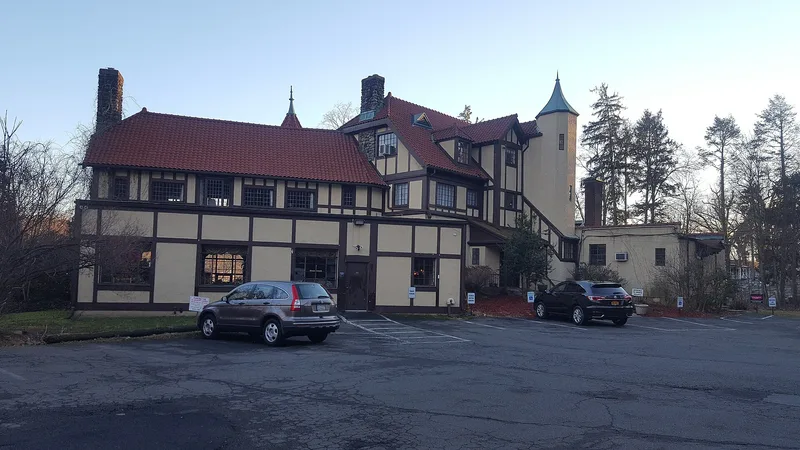
Set on a five-acre lot in Hartsdale, Westchester County, this Y-shaped, two-and-one-half-story house has a fieldstone first floor, half-timbered stucco upper stories, a red tile roof and octagonal stair towers. A plain house of about 1870 was enlarged and remodeled in the early 1920s into its present Tudor Revival form. Evangeline Booth, who commanded the Salvation Army in the United States from 1904 to 1934 and later served as General of the international organization, lived here from about 1919 until her death in 1950. The house served as her base between long journeys. She left it to the Salvation Army, which sold it in 1951 to St. Andrew's Episcopal Church. The church added a chapel in 1955 that harmonizes with the original design. The interior includes a library open to the roof with carved stone bosses and a large stone fireplace. The property is recognized for Booth's national importance in charity and social work and for its architecture.
Significance in brief: The house was the longtime home and base of Evangeline Booth, who led the Salvation Army in the United States from 1904 to 1934 and later served as General of the International Salvation Army. It is nationally significant under Criteria A and B for health/medicine and social history. It is also significant under Criterion C as a good example of Tudor Revival domestic architecture in Westchester County.
Machine-generated summary. This summary was generated by a language model from the official nomination document and has not been reviewed line by line by an editor. It may contain errors. Check the source document before relying on any detail. Source: nomination document (PDF) · National Archives catalog entry. NRHP reference 11000040, listed February 22, 2011. Summary generated October 2026 (model claude-sonnet-5-5, prompt v1.0-2026-10-29, confidence high).
Key facts
| Address | 101 N Central Ave, Hartsdale |
|---|---|
| County | Westchester County |
| Listed | February 22, 2011 |
| Reference number | 11000040 |
| Resource type | Building |
| Period of significance | c. 1919-1955 |
| Architect / builder | Walker, James E. (builder) |
| Architectural style | Late 19th and 20th Century Revivals: Tudor Revival |
| Criteria |
|
| Areas of significance | Health/Medicine, Social History, Architecture |
| Level of significance | National |
| Status (as stated in the nomination) | Now used as St. Andrew's Episcopal Church; the carriage house has been converted to office rental and the house is described as highly intact. |
| Acreage | 5.5 |
| Within district | Bronx River Parkway Reservation |
| Coordinates | 41.02444, -73.79581 (NPS GIS) |
What listing means for this property
National Register listing is honorary for a privately owned home: it does not by itself restrict what an owner may do with their own money, and it does not require public access. Restrictions come from local landmark or historic-district ordinances, which are separate (how they differ).
Owner-occupied houses are not eligible for the 20% federal rehabilitation tax credit, which applies to income-producing buildings, but many states offer credits for homeowners. Listing also opens the door to preservation easements and to buying a plaque. Start with what listing means for homeowners, renovating a listed house and selling one.
General information, not legal or tax advice. Rules change; confirm with your State Historic Preservation Office or a qualified adviser.
Sources and further reading
- National Park Service, National Register of Historic Places database (snapshot May 2026), reference 11000040.
- Nomination form (PDF, National Archives) — catalog entry
- Wikipedia article (used for cross-checking only; text not reproduced here)
- Wikidata Q5415795
- This listing as JSON
Last updated October 2026. Found an error? See the editorial policy for how to report it.