North Creek Railroad Station Complex

Why it's listed
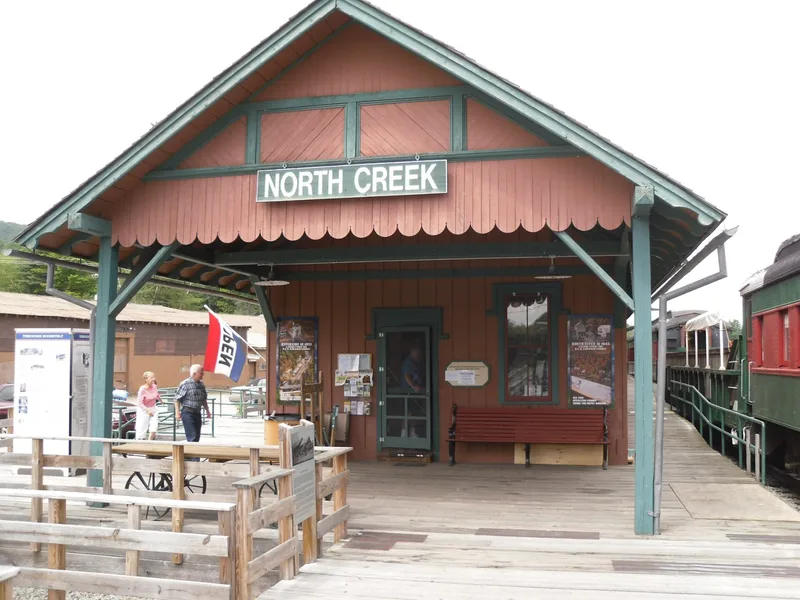
North Creek Railroad Station Complex is a group of railroad buildings on the south bank of the Hudson River in the Adirondack hamlet of North Creek. The main station, built in 1874, is a rectangular, gable-roofed building in the stick style, with broad strut-supported eaves, board-and-batten walls and a sheltering platform porch. Nearby are a freight house, round house, tool house and turntable, along with the small 1871 original station and a horse barn that once served the stage line to Blue Mountain Lake. The complex marks the northern end of the Adirondack Railroad, a line promoted by Thomas C. Durant that carried freight and summer visitors into the region. It is best remembered as the place where Theodore Roosevelt, after a night journey from Tahawus, learned in September 1901 that President McKinley had died. The buildings remain remarkably intact, and rail service continues because of a nearby garnet mine.
Significance in brief: The station is where Theodore Roosevelt learned in September 1901 that President McKinley had died and that he had become president. It was also the northernmost terminus of the Adirondack Railroad, which opened the central Adirondacks to recreation and industry. The complex survives as an unusually intact group of railroad structures.
Machine-generated summary. This summary was generated by a language model from the official nomination document and has not been reviewed line by line by an editor. It may contain errors. Check the source document before relying on any detail. Source: nomination document (PDF) · National Archives catalog entry. NRHP reference 76001287, listed August 27, 1976. Summary generated October 2026 (model claude-sonnet-5-5, prompt v1.0-2026-10-29, confidence high).
Key facts
| Address | Railroad Pl., North Creek |
|---|---|
| County | Warren County |
| Listed | August 27, 1976 |
| Reference number | 76001287 |
| Resource type | Building |
| Period of significance | 1871-74 |
| Architectural style | Stick style (stick elements) |
| Areas of significance | Transportation, Politics/Government, Architecture |
| Level of significance | State |
| Status (as stated in the nomination) | The station, freight house and other railroad structures remain in use, serving a garnet mine; the old station and horse barn are unused. The form describes the buildings as remarkably intact and largely unaltered since construction. |
| Acreage | 6 |
| Coordinates | 43.70292, -73.98935 (NPS GIS) |
What listing means for this property
For an income-producing building, listing (individually or as a contributing building in a district) is the gateway to the 20% federal rehabilitation tax credit on qualified rehabilitation costs, often stackable with state credits. Work claiming the credit must follow the Secretary of the Interior's Standards and be approved in advance.
Listing does not restrict a private owner acting without federal money or permits; where federal funding or licensing is involved, Section 106 review applies.
General information, not legal or tax advice. Rules change; confirm with your State Historic Preservation Office or a qualified adviser.
Sources and further reading
- National Park Service, National Register of Historic Places database (snapshot May 2026), reference 76001287.
- Nomination form (PDF, National Archives) — catalog entry
- Wikipedia article (used for cross-checking only; text not reproduced here)
- Wikidata Q7054969
- This listing as JSON
Last updated October 2026. Found an error? See the editorial policy for how to report it.