Tuthilltown Gristmill
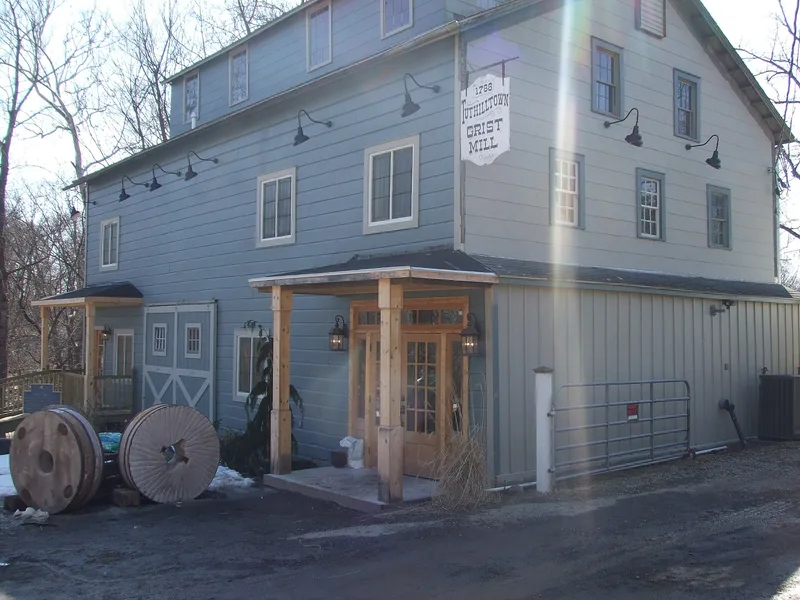

Why it's listed
Water has turned the machinery of this three-story timber frame mill on the Shawangunk Kill in Gardiner, New York, since Selah Tuthill established it in 1788. Built on a fieldstone foundation under a gable roof with a clerestory monitor, it grew through several additions, including a one-story store added in 1943. Power came first from an undershot wheel, then an overshot wheel, and since 1900 from a Leffel water turbine. Four run of millstones once operated on the first floor, and the mill still holds its full set of stones, cranes, bagging chutes, fanning and bolting machines and conveyors, mostly installed in the late nineteenth century. Only one run of stones is now used commercially. The nominated 1.4 acres include the building, the dam and the mill race. The mill is described as the oldest operating grist mill in Ulster County and has continuously served local customers, with kosher flour as a specialty product.
Significance in brief: The nomination argues the mill is significant as a custom merchant mill in continuous commercial operation since the eighteenth century. Its dam, headrace and successive conversions to more efficient water power reflect the engineering history of rural New York grain mills. Its machinery represents vernacular milling technology of about 1880-1910, and it is the oldest operating grist mill in Ulster County.
Machine-generated summary. This summary was generated by a language model from the official nomination document and has not been reviewed line by line by an editor. It may contain errors. Check the source document before relying on any detail. Source: nomination document (PDF) · National Archives catalog entry. NRHP reference 82003409, listed June 14, 1982. Summary generated October 2026 (model claude-sonnet-5-5, prompt v1.0-2026-10-29, confidence high).
Key facts
| Address | Albany Post Rd., Gardiner |
|---|---|
| County | Ulster County |
| Listed | June 14, 1982 |
| Reference number | 82003409 |
| Resource type | Building |
| Period of significance | 1700-1799, 1800-1899, 1900- (specific dates: 1788, with additions) |
| Criteria |
|
| Areas of significance | Architecture |
| Level of significance | Local |
| Status (as stated in the nomination) | Occupied and in good condition; still in commercial operation, grinding corn, rye and wheat from October to May, with one run of stones in use. |
| Acreage | 1.4 |
| Coordinates | 41.68673, -74.17520 (NPS GIS) |
What listing means for this property
National Register listing is honorary: it recognises significance and does not restrict what a private owner may do without federal money or permits. It unlocks the 20% federal rehabilitation tax credit for income-producing buildings, state credits in many states, and Section 106 review when federal agencies are involved. See what listing means in practice.
General information, not legal or tax advice. Rules change; confirm with your State Historic Preservation Office or a qualified adviser.
Sources and further reading
- National Park Service, National Register of Historic Places database (snapshot May 2026), reference 82003409.
- Nomination form (PDF, National Archives) — catalog entry
- Wikipedia article (used for cross-checking only; text not reproduced here)
- Wikidata Q7856932
- This listing as JSON
Last updated October 2026. Found an error? See the editorial policy for how to report it.