Reformed Church of Shawangunk Complex

Why it's listed
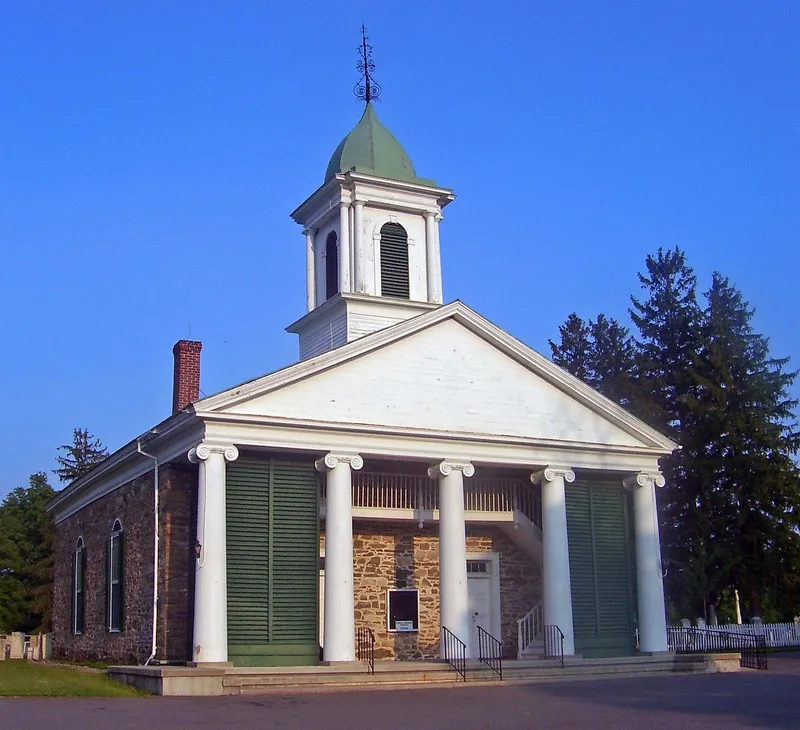
Along Hoagerburgh Road east of Bruynswick, a four-acre complex centers on a dressed fieldstone church built in 1755. It was renovated around 1797 and given a Greek Revival Ionic portico and tower, added in 1815 and altered in 1839. Twin exterior staircases lead to a balcony and the interior gallery. Across the road stand a fieldstone parsonage dating to 1751, restored in 1943 to its late eighteenth-century appearance, and a nineteenth-century carriage house with mortise-and-tenon framing. A 1916 assembly hall, funded largely by a youth temperance group, retains its pressed metal walls and ceiling. The burial ground east of the church holds several hundred stones, the oldest dated 1752, ranging from rough building stones to sandstone and marble markers. The nomination presents the complex as a local landmark reflecting the Dutch heritage and gradual growth of rural southwestern Ulster County, with a congregation that has used the church continuously for over two centuries.
Significance in brief: The nomination argues the church and parsonage are superb examples of vernacular stone architecture on the Shawangunk River plain and a visual landmark of rural Ulster County. Its continuous use as a spiritual center and its ties to the area's Dutch settlement add to its local significance. The ancillary buildings and the burial ground, with stones from 1752 onward, document the complex's long evolution.
Machine-generated summary. This summary was generated by a language model from the official nomination document and has not been reviewed line by line by an editor. It may contain errors. Check the source document before relying on any detail. Source: nomination document (PDF) · National Archives catalog entry. NRHP reference 82003408, listed June 3, 1982. Summary generated October 2026 (model claude-sonnet-5-5, prompt v1.0-2026-10-29, confidence high).
Key facts
| Address | Hoagerburgh Rd., Bruynswick |
|---|---|
| County | Ulster County |
| Listed | June 3, 1982 |
| Reference number | 82003408 |
| Resource type | Building |
| Architectural style | Greek Revival portico and tower on a vernacular stone church; Federal period interior alterations |
| Areas of significance | Exploration/Settlement, Architecture |
| Level of significance | Local |
| Status (as stated in the nomination) | Listed as in excellent condition and altered, on its original site. The church has been in continuous use as a house of worship since 1755, and the burial ground lies within an active modern cemetery. |
| Acreage | 4 |
| Coordinates | 41.65349, -74.21394 (NPS GIS) |
What listing means for this property
Religious properties are listed for their architectural or historical significance, not their religious use. Listing is honorary and does not restrict the congregation's use of the building. The federal rehabilitation credit is generally unavailable unless part of the building is income-producing; some state programmes and preservation grants do cover religious buildings. Federal funding or permits trigger Section 106 review.
General information, not legal or tax advice. Rules change; confirm with your State Historic Preservation Office or a qualified adviser.
Sources and further reading
- National Park Service, National Register of Historic Places database (snapshot May 2026), reference 82003408.
- Nomination form (PDF, National Archives) — catalog entry
- Wikipedia article (used for cross-checking only; text not reproduced here)
- Wikidata Q7307493
- This listing as JSON
Last updated October 2026. Found an error? See the editorial policy for how to report it.