Main-Partition Streets Historic District

Why it's listed
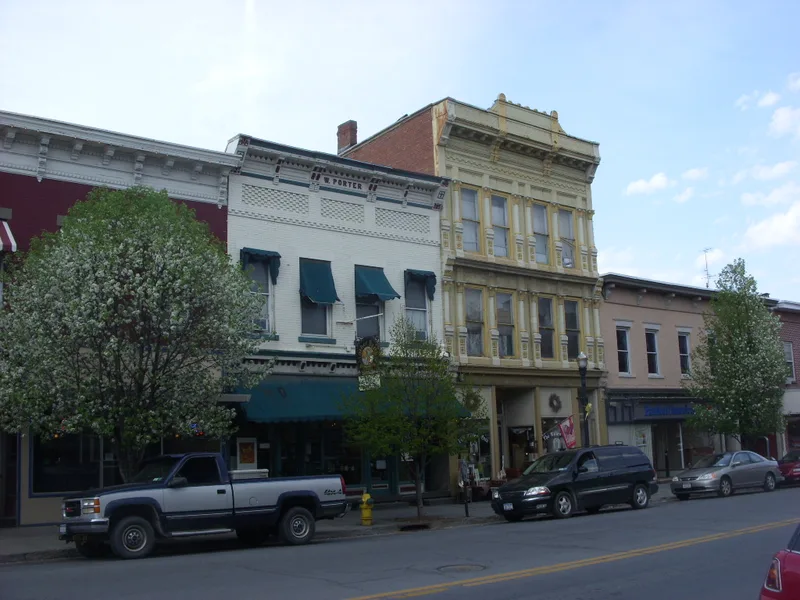
Saugerties' historic business core lies along Main, Partition, Market and Jane Streets, where 83 structures form a compact, small-scale commercial district above the mouth of the Esopus Creek. Most are two- or three-story brick stores with apartments or storage above, built mainly in the second half of the nineteenth century. The village grew from a small mill hamlet after businessman Henry Barclay established an iron works and paper mill in the 1820s, and later relied on bluestone shipping, brickmaking and tourism. Surviving landmarks include a 1780s public house, the 1827 Phoenix Hotel, the Exchange Hotel, and two churches in round-arched styles. Two storefronts have complete galvanized sheet-iron facades shipped from Mesker Brothers of St. Louis, and several Victorian buildings carry named, dated rooftop pediments. Bluestone sidewalks remain in front of most shops. Limited twentieth-century growth left few modern intrusions, so the streetscape still conveys a nineteenth-century riverside village.
Significance in brief: The nomination argues the district has both historical and architectural significance. Its buildings from many periods record nineteenth-century building styles and reflect the commercial and social changes of upper Hudson Valley communities. Notable features include two complete Mesker Brothers iron fronts, Romanesque Revival churches, late Victorian dated pediments and historic bluestone sidewalks.
Machine-generated summary. This summary was generated by a language model from the official nomination document and has not been reviewed line by line by an editor. It may contain errors. Check the source document before relying on any detail. Source: nomination document (PDF) · National Archives catalog entry. NRHP reference 82003411, listed July 8, 1982. Summary generated October 2026 (model claude-sonnet-5-5, prompt v1.0-2026-10-29, confidence high).
Key facts
| Address | Roughly bounded by Main, Partition, Market and Jane Sts., Saugerties |
|---|---|
| County | Ulster County |
| Listed | July 8, 1982 |
| Reference number | 82003411 |
| Resource type | District |
| Period of significance | c1780-1900 |
| Architect / builder | Various |
| Areas of significance | Commerce, Architecture |
| Level of significance | Local |
| Status (as stated in the nomination) | Described as in excellent to good condition, with some altered storefronts, few modern intrusions, and an intact core of the nineteenth-century business district. Present uses include commercial, private residence, religious and government. |
| Acreage | 12 |
| Coordinates | 42.07723, -73.95298 (NPS GIS) |
What listing means for this property
This is a historic district. Buildings within its boundary are either contributing (they add to the district's significance) or non-contributing. Owners of contributing income-producing buildings can claim the 20% federal rehabilitation tax credit; homeowners should look at state credits. National Register districts impose no design review by themselves; a local historic district ordinance, if one exists, does (the difference explained).
General information, not legal or tax advice. Rules change; confirm with your State Historic Preservation Office or a qualified adviser.
Sources and further reading
- National Park Service, National Register of Historic Places database (snapshot May 2026), reference 82003411.
- Nomination form (PDF, National Archives) — catalog entry
- Wikipedia article (used for cross-checking only; text not reproduced here)
- Wikidata Q6736855
- This listing as JSON
Last updated October 2026. Found an error? See the editorial policy for how to report it.