Town Doctors' House and Site

Why it's listed
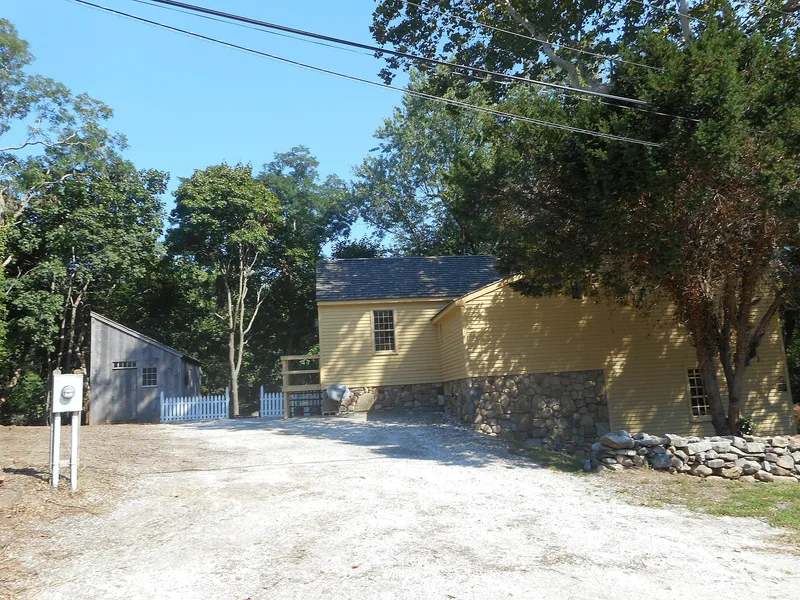
Set beside Bilberry Swamp on Ackerly Pond Lane in Southold, this small property combines an early colonial house with an archaeological site. The timber-framed house, estimated at around 1720, has two and one-half stories, a central brick chimney and a plan of two rooms flanking a central hearth, following New England Colonial patterns brought by settlers from the New Haven Colony. Additions came around 1880, 1930 and in 2002-2003. The land was set aside in 1664 for Dr. Robert Trusteane, the town physician, though few later residents were doctors and the house briefly served as a select school in the 1830s. Excavations have recovered household items from the eighteenth through twentieth centuries, evidence of mid-nineteenth century clothing work, and Late Archaic Native American tools, suggesting berry gathering at the wetland. The property was listed for its role in Southold's settlement, its surviving early architecture and its archaeological potential.
Significance in brief: The nomination argues the property reflects Southold's early settlement and its cultural ties to New England (Criterion A). It also presents the house as a rare surviving early-eighteenth century colonial example (Criterion C). The site has yielded and may yield archaeological information from Late Archaic Native American use and from eighteenth to twentieth century occupation (Criterion D).
Machine-generated summary. This summary was generated by a language model from the official nomination document and has not been reviewed line by line by an editor. It may contain errors. Check the source document before relying on any detail. Source: nomination document (PDF) · National Archives catalog entry. NRHP reference 04001448, listed January 5, 2005. Summary generated October 2026 (model claude-sonnet-5-5, prompt v1.0-2026-10-29, confidence medium).
Key facts
| Address | 310 Ackerly Pond Ln., Southold |
|---|---|
| County | Suffolk County |
| Listed | January 5, 2005 |
| Reference number | 04001448 |
| Resource type | Building |
| Period of significance | ca. 1706-1954 |
| Architect / builder | unknown |
| Architectural style | New England Colonial |
| Criteria |
|
| Areas of significance | Exploration/Settlement, Community Planning and Development, Architecture, European, Native American |
| Level of significance | Local |
| Status (as stated in the nomination) | Used as a residence; the house was restored and expanded in 2002-2003, and the site has been partly excavated. |
| Acreage | 0.9 |
| Coordinates | 41.05709, -72.43612 (NPS GIS) |
What listing means for this property
National Register listing is honorary for a privately owned home: it does not by itself restrict what an owner may do with their own money, and it does not require public access. Restrictions come from local landmark or historic-district ordinances, which are separate (how they differ).
Owner-occupied houses are not eligible for the 20% federal rehabilitation tax credit, which applies to income-producing buildings, but many states offer credits for homeowners. Listing also opens the door to preservation easements and to buying a plaque. Start with what listing means for homeowners, renovating a listed house and selling one.
General information, not legal or tax advice. Rules change; confirm with your State Historic Preservation Office or a qualified adviser.
Sources and further reading
- National Park Service, National Register of Historic Places database (snapshot May 2026), reference 04001448.
- Nomination form (PDF, National Archives) — catalog entry
- Wikipedia article (used for cross-checking only; text not reproduced here)
- Wikidata Q7829945
- This listing as JSON
Last updated October 2026. Found an error? See the editorial policy for how to report it.