Quogue Life-Saving Station

Why it's listed
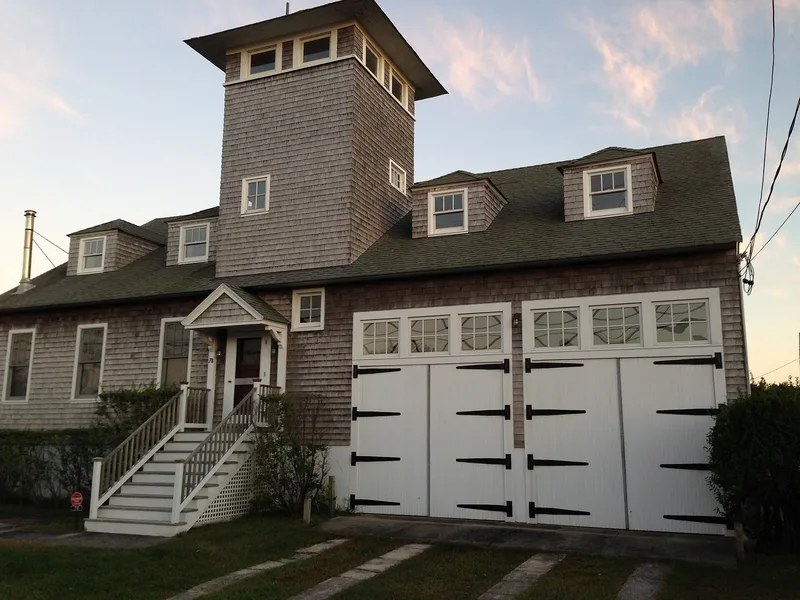
Built in 1912 on a barrier beach south of Quogue village, this life-saving station housed the crew and equipment of the U.S. Life-Saving Service. It follows one of several standard designs prepared by staff architect Victor Mendleheff, and is called the Lorain Type. The wood-framed building sits on a concrete foundation, is clad in wood shingles, and has a four-story lookout tower at the center of its north front. Its flared gable ends hint at the Shingle Style. Interior layout and finishes remain largely intact, including plaster walls, wainscoting, panel doors and the old crew quarters. Alterations in 1931 and 1939 enclosed porches, lowered the boatroom floor and ceiling, and enlarged the kitchen. The station later served the Coast Guard and the Navy before being sold in 1948. It is now a private home restored after 1994. It is considered one of the best-preserved pre-1915 stations on Long Island and recalls local rescues and wartime beach patrols.
Significance in brief: It is argued to be significant under Criterion C as a highly intact example of a coastal rescue station built by the U.S. Life-Saving Service, and one of the most intact of only ten or twelve pre-1915 stations surviving on Long Island. It was designed by staff architect Victor Mendleheff and also reflects maritime rescue history at Quogue, including later Coast Guard and Navy use.
Machine-generated summary. This summary was generated by a language model from the official nomination document and has not been reviewed line by line by an editor. It may contain errors. Check the source document before relying on any detail. Source: nomination document (PDF) · National Archives catalog entry. NRHP reference 99000640, listed May 27, 1999. Summary generated October 2026 (model claude-sonnet-5-5, prompt v1.0-2026-10-29, confidence medium).
Key facts
| Address | 78 Dune Rd., Quogue |
|---|---|
| County | Suffolk County |
| Listed | May 27, 1999 |
| Reference number | 99000640 |
| Resource type | Building |
| Period of significance | 1912-1948 |
| Architect / builder | Mendleff, Victor (U.S. Life-Saving Service) |
| Architectural style | Late Victorian: Shingle Style |
| Criteria |
|
| Areas of significance | Architecture, Maritime History |
| Level of significance | National |
| Status (as stated in the nomination) | Currently a single-family dwelling, restored after 1994 purchase; wood shingles replaced the cement-asbestos covering and a new asphalt roof was installed. |
| Acreage | 0.9 |
| Coordinates | 40.80743, -72.59947 (NPS GIS) |
What listing means for this property
For an income-producing building, listing (individually or as a contributing building in a district) is the gateway to the 20% federal rehabilitation tax credit on qualified rehabilitation costs, often stackable with state credits. Work claiming the credit must follow the Secretary of the Interior's Standards and be approved in advance.
Listing does not restrict a private owner acting without federal money or permits; where federal funding or licensing is involved, Section 106 review applies.
General information, not legal or tax advice. Rules change; confirm with your State Historic Preservation Office or a qualified adviser.
Sources and further reading
- National Park Service, National Register of Historic Places database (snapshot May 2026), reference 99000640.
- Nomination form (PDF, National Archives) — catalog entry
- Wikipedia article (used for cross-checking only; text not reproduced here)
- Wikidata Q7272834
- This listing as JSON
Last updated October 2026. Found an error? See the editorial policy for how to report it.