Market Street Historic District (Boundary Increase)

Why it's listed
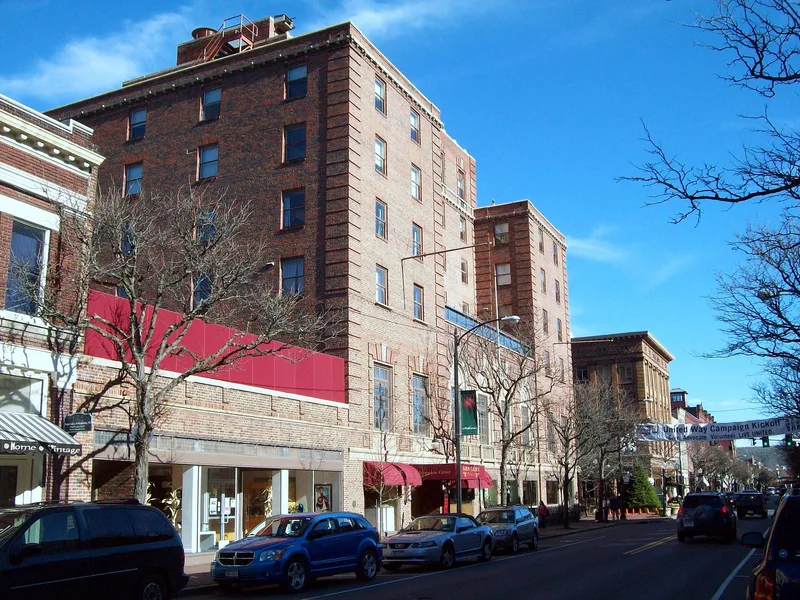
Market Street in Corning's central business area holds a long row of commercial buildings, and this nomination extends the existing historic district westward by twelve buildings while adding a full building survey. The original district, listed in 1974, covered four blocks and 108 buildings but lacked a complete description. The added buildings had been left out earlier because of their dilapidated condition and owner disinterest, and they now resemble the original district in character and condition. Together the district totals 109 contributing and 11 non-contributing resources. The buildings range from c. 1850 Greek Revival and frame structures to Italianate, Victorian Gothic, Romanesque Revival and Renaissance Revival blocks, with Moderne and early twentieth-century facades. Notable examples include the Boston Store, Hayt's Mill Building, the former City Hall of 1893 and the Steuben Building. The district is recognized for commerce and architecture, with a period of significance from about 1850 to about 1950.
Significance in brief: The form states the extension is significant under Criterion C in architecture as an intact collection of nineteenth- and twentieth-century commercial structures. It is also marked under Criterion A for commerce. The added buildings now match the character and condition of those in the original district.
Machine-generated summary. This summary was generated by a language model from the official nomination document and has not been reviewed line by line by an editor. It may contain errors. Check the source document before relying on any detail. Source: nomination document (PDF) · National Archives catalog entry. NRHP reference 00001152, listed October 6, 2000. Summary generated October 2026 (model claude-sonnet-5-5, prompt v1.0-2026-10-29, confidence medium).
Key facts
| Address | N side of Market St. from Chestnut St. and Bridge St., Corning |
|---|---|
| County | Steuben County |
| Listed | October 6, 2000 |
| Reference number | 00001152 |
| Resource type | District |
| Period of significance | ca. 1850 - ca. 1950 |
| Architect / builder | various |
| Architectural style | Greek Revival, Romanesque Revival, Italianate, High Victorian Gothic, Classical Revival, Italian Renaissance, Moderne |
| Criteria |
|
| Areas of significance | Commerce, Architecture |
| Level of significance | Local |
| Status (as stated in the nomination) | Buildings are in commercial and residential use; current functions include specialty stores, restaurants, organizations and single dwellings. |
| Acreage | 0.9 |
| Coordinates | 42.14450, -77.05926 (NPS GIS) |
What listing means for this property
This is a historic district. Buildings within its boundary are either contributing (they add to the district's significance) or non-contributing. Owners of contributing income-producing buildings can claim the 20% federal rehabilitation tax credit; homeowners should look at state credits. National Register districts impose no design review by themselves; a local historic district ordinance, if one exists, does (the difference explained).
General information, not legal or tax advice. Rules change; confirm with your State Historic Preservation Office or a qualified adviser.
Sources and further reading
- National Park Service, National Register of Historic Places database (snapshot May 2026), reference 00001152.
- Nomination form (PDF, National Archives) — catalog entry
- Wikipedia article (used for cross-checking only; text not reproduced here)
- Wikidata Q6770757
- This listing as JSON
Last updated October 2026. Found an error? See the editorial policy for how to report it.