Gansevoort/East Steuben Streets Historic District

Why it's listed
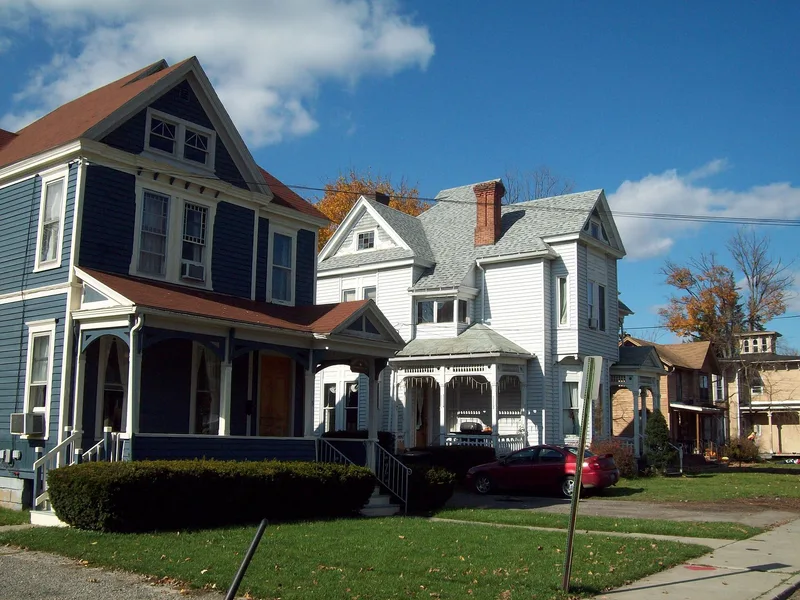
Twenty-two houses along Gansevoort and East Steuben Streets, just northeast of Pulteney Square in Bath, form a small enclave of middle-class housing built between about 1830 and 1908. Most are two-story frame dwellings on lots under an acre, and their similar scale gives the three-block area a cohesive look. The houses show a range of styles: Greek Revival examples from the 1830s and 1840s, including the Ten Eyck Gansevoort House and the brick McMaster/Parkhurst House; Italianate houses with bracketed eaves and cupolas from Bath's railroad-era prosperity; Queen Anne houses with multi-gabled roofs; and one Colonial Revival house. Owners included a lawyer and county judge, a produce dealer, a carriage maker and a department store partner. The district is considered the only intact nineteenth-century middle-class residential neighborhood left in the village, and its boundaries exclude the modern and altered buildings nearby.
Significance in brief: It is described as the only intact nineteenth-century middle-class residential neighborhood in Bath. It contains a significant concentration of Greek Revival, Italianate and Queen Anne houses, many tied to locally prominent merchants and businessmen. The streets were among the earliest laid out when the village was planned in the late eighteenth century.
Machine-generated summary. This summary was generated by a language model from the official nomination document and has not been reviewed line by line by an editor. It may contain errors. Check the source document before relying on any detail. Source: nomination document (PDF) · National Archives catalog entry. NRHP reference 83001798, listed September 30, 1983. Summary generated October 2026 (model claude-sonnet-5-5, prompt v1.0-2026-10-29, confidence medium).
Key facts
| Address | E. Steuben and Gansevoort Sts., Bath |
|---|---|
| County | Steuben County |
| Listed | September 30, 1983 |
| Reference number | 83001798 |
| Resource type | District |
| Architectural style | Greek Revival, Italianate, Queen Anne, Colonial Revival, and late nineteenth-century eclectic |
| Areas of significance | Community Planning and Development, Architecture |
| Level of significance | Local |
| Status (as stated in the nomination) | Described as substantially intact with no intrusions; the former octagon house at 117 East Steuben Street was substantially altered when converted to county office space. |
| Acreage | 8 |
| Coordinates | 42.33446, -77.31541 (NPS GIS) |
What listing means for this property
This is a historic district. Buildings within its boundary are either contributing (they add to the district's significance) or non-contributing. Owners of contributing income-producing buildings can claim the 20% federal rehabilitation tax credit; homeowners should look at state credits. National Register districts impose no design review by themselves; a local historic district ordinance, if one exists, does (the difference explained).
General information, not legal or tax advice. Rules change; confirm with your State Historic Preservation Office or a qualified adviser.
Sources and further reading
- National Park Service, National Register of Historic Places database (snapshot May 2026), reference 83001798.
- Nomination form (PDF, National Archives) — catalog entry
- Wikipedia article (used for cross-checking only; text not reproduced here)
- Wikidata Q5521493
- This listing as JSON
Last updated October 2026. Found an error? See the editorial policy for how to report it.