Erie Freighthouse Historic District

Why it's listed
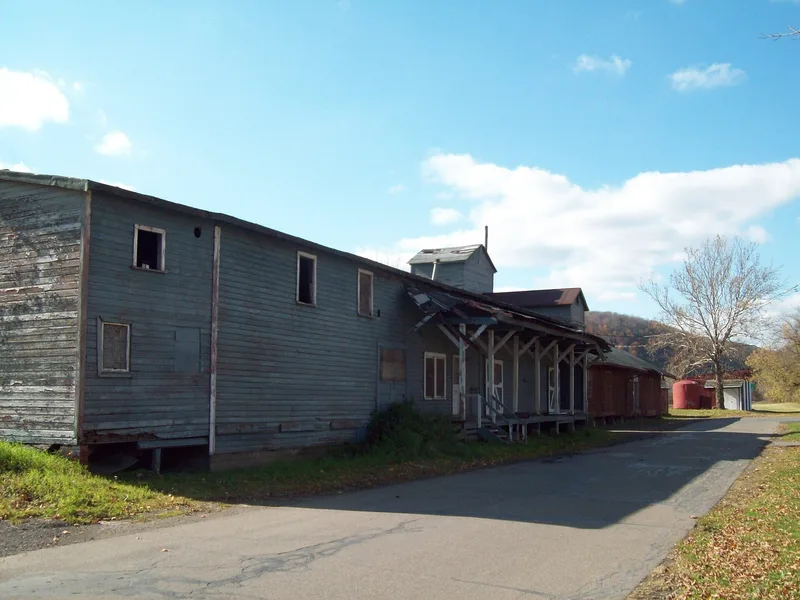
Near the corner of Cohocton Street and Railroad Avenue in Bath, New York, a group of six utilitarian buildings records the village's long dependence on the Erie Railroad. The group includes the board-and-batten Erie freighthouse, begun around 1852 and doubled in length by 1873, along with G.L.F. farm service and machinery buildings, the gambrel-roofed E. H. Dudley warehouse of 1904-1909, and the three-story concrete-block Bath Harness Company factory of 1906. Each was built to move goods to or from rail cars, store them, or make products shipped by rail. The boundaries were drawn around the largest intact collection of such buildings in Bath. The buildings changed little between the 1930s and the time of listing, and most still serve commercial purposes. The district was recognized for its architecture and its role in local commerce between about 1852 and 1937, and for showing how rail-related business sat beside homes just west of Pultney Square.
Significance in brief: The district is argued to be the largest intact concentration of railroad-related commercial buildings in Bath. Its buildings show how goods were transferred, stored and manufactured around rail service from 1852 through the mid-1930s. They also show how rail-related commerce coexisted with a residential neighborhood in a small upstate town.
Machine-generated summary. This summary was generated by a language model from the official nomination document and has not been reviewed line by line by an editor. It may contain errors. Check the source document before relying on any detail. Source: nomination document (PDF) · National Archives catalog entry. NRHP reference 91000235, listed March 18, 1991. Summary generated October 2026 (model claude-sonnet-5-5, prompt v1.0-2026-10-29, confidence high).
Key facts
| Address | Jct. of Cohocton St. and Railroad Ave., Bath |
|---|---|
| County | Steuben County |
| Listed | March 18, 1991 |
| Reference number | 91000235 |
| Resource type | District |
| Period of significance | c1852-c1937 |
| Architectural style | Late Victorian: Other: board and batten; No style: wood-framed warehouse, rectangular plan |
| Criteria |
|
| Areas of significance | Commerce, Architecture |
| Level of significance | Local |
| Status (as stated in the nomination) | Five of the six contributing buildings remain in commercial use, and the Dudley warehouse still serves as a lumber and building materials store. The G.L.F. Farm Machinery Storage building is the exception. Buildings are generally sound, though the Dudley warehouse leans and risks collapse. |
| Acreage | 1.7 |
| Coordinates | 42.33347, -77.32576 (NPS GIS) |
What listing means for this property
This is a historic district. Buildings within its boundary are either contributing (they add to the district's significance) or non-contributing. Owners of contributing income-producing buildings can claim the 20% federal rehabilitation tax credit; homeowners should look at state credits. National Register districts impose no design review by themselves; a local historic district ordinance, if one exists, does (the difference explained).
General information, not legal or tax advice. Rules change; confirm with your State Historic Preservation Office or a qualified adviser.
Sources and further reading
- National Park Service, National Register of Historic Places database (snapshot May 2026), reference 91000235.
- Nomination form (PDF, National Archives) — catalog entry
- Wikipedia article (used for cross-checking only; text not reproduced here)
- Wikidata Q5388306
- This listing as JSON
Last updated October 2026. Found an error? See the editorial policy for how to report it.