Davenport Library
Also known as: 101-42-0028

Why it's listed
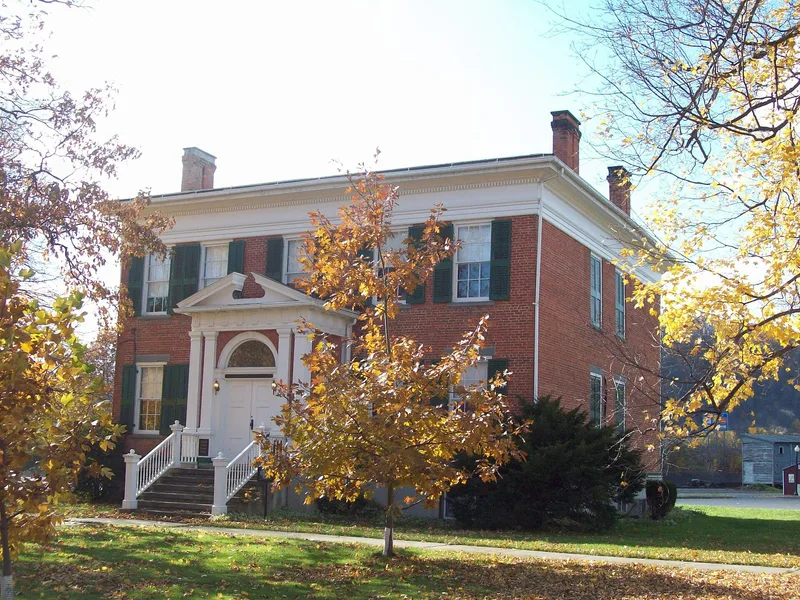
Davenport Library is a two-story brick building on a raised basement, set on a 2.5-acre lot on the sparsely settled southern edge of Bath, New York. It began about 1830 as a Greek Revival residence built by John McGee, an early settler who organized the Steuben County Bank, helped bring the railroad to Bath and served two terms in Congress. By 1857 it had been remodeled in an elaborate Italianate manner, with paired brackets, a cupola and a portico. Ambrose Howell, a local merchant, acquired it in 1863. Ira Davenport bought it in 1893 and turned it over to the village as a library. It was remodeled again, showing Colonial Revival influence, while keeping details such as the wide frieze with egg and dart molding and a denticular cornice. The Davenport family is noted for founding the Home for Orphan Girls and for bringing the Soldiers' Home to Bath. The library passed to the Library Association after Davenport's death in 1904 and remains an early twentieth century cultural and educational center.
Significance in brief: The nomination cites its association with the Davenport family, a wealthy and philanthropic Bath family of the nineteenth century. It also describes the building as a local landmark and an early twentieth century center of cultural and educational activity. Its first owner, John McGee, was an important early settler.
Machine-generated summary. This summary was generated by a language model from the official nomination document and has not been reviewed line by line by an editor. It may contain errors. Check the source document before relying on any detail. Source: nomination document (PDF) · National Archives catalog entry. NRHP reference 83001797, listed September 30, 1983. Summary generated October 2026 (model claude-sonnet-5-5, prompt v1.0-2026-10-29, confidence medium).
Key facts
| Address | W. Morris St., Bath |
|---|---|
| County | Steuben County |
| Listed | September 30, 1983 |
| Reference number | 83001797 |
| Resource type | Building |
| Architect / builder | Architect: Unknown; Builder: Unknown (the form says the residence was constructed c. 1830 by John McGee) |
| Architectural style | Originally Greek Revival, later Italianate, then remodeled with Colonial Revival influence |
| Areas of significance | Community Planning and Development, Education |
| Level of significance | Local |
| Status (as stated in the nomination) | Present use is a library, in fair condition, on its original site, with no threats known. |
| Acreage | 2.5 |
| Coordinates | 42.33287, -77.32416 (NPS GIS) |
What listing means for this property
For a publicly owned building or structure, listing mainly matters when federal funds, permits or licences are involved: projects then go through Section 106 review so effects on the property are considered. Listing also strengthens applications for preservation grants and, for leased income-producing uses, can enable the federal rehabilitation tax credit.
General information, not legal or tax advice. Rules change; confirm with your State Historic Preservation Office or a qualified adviser.
Sources and further reading
- National Park Service, National Register of Historic Places database (snapshot May 2026), reference 83001797.
- Nomination form (PDF, National Archives) — catalog entry
- Wikipedia article (used for cross-checking only; text not reproduced here)
- Wikidata Q5230247
- This listing as JSON
Last updated October 2026. Found an error? See the editorial policy for how to report it.